

You are standing at a rock quarry. The ground is hard granite. You need to drill blast holes – fast, straight, and deep. A top hammer drill bounces and loses power. But a down the hole drilling rig puts the hammer right behind the bit, deep in the hole. Every blow hits the rock directly. No energy wasted. That is the power of a DTH rig.
YG Machinery offers five YGS series rigs: 100A, 153, 180, 300, and 350. They drill holes from 83mm up to 165mm in diameter. Weights range from 3.8 to 8 tons. Whether you are blasting for aggregates, drilling water wells, or installing anchor bolts, there is a YGS model for your excavator or loader.
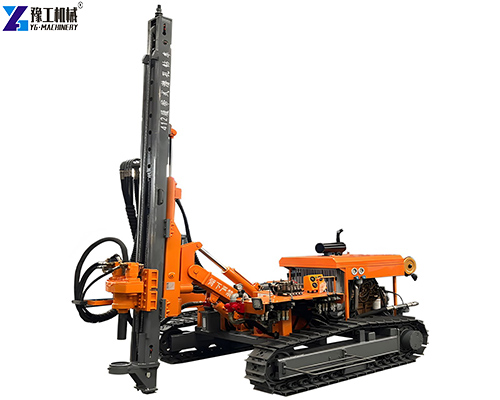
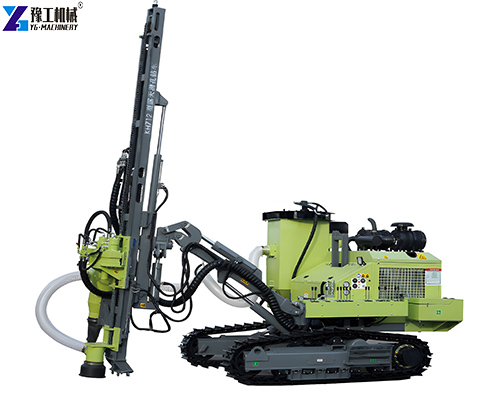
YGS Series Down The Hole Drilling Rig
Here are the core specifications for all five models. Compare them to find your match.
| Model | YGS100A | YGS153 | YGS180 | YGS300 | YGS350 |
| Total weight | 5.95T | 3.8T | 6.3T | 6.8T | 8T |
| Walking speed | 2.5km/h | 2.5km/h | 2.5km/h | 2.2/3.8km/h | 4km/h 2km/h |
| Diesel tank capacity | 85L | 70L | 85L | 85L | 225L |
| Shipping size | 6500*2100*2400mm | 4640*1980*2260mm | 6600*2110*2500mm | 6600*2220*2600mm | 7600*2350*2800mm |
| Drilling hole diameter | 90-146mm | 83-130mm | 90-146mm | 90-152mm | 90-165mm |
| Power configuration | YCD4R22T-80 | YC2108 33kw/2400rpm | YCD4R22T-80 55kw | YC4DK80-T302 | YC4DK100-T304 73.5kw/2200rpm |
| Highest horizontal hole height | 3.2m | 2.8m | 3.6m | 3.25m | 3.5m |
What Makes A Down The Hole Drilling Rig Better Than Other Drills?
Unlike a top hammer drill that strikes from above, a down hole drilling equipment has the hammer inside the hole, directly behind the bit. This gives three big advantages:
- Straighter holes – The drill string does not bend or bounce. The hole stays true.
- Faster penetration – No energy is lost through long steel rods. Every blow goes into the rock.
- Less wear – The hammer is submerged in flushing air, which cools and cleans it.
For hard rock (granite, basalt, limestone), a DTH rig is the industry standard. Quarry operators, road builders, and foundation contractors all rely on them.
Core Components Of A Down Hole Drilling Rig
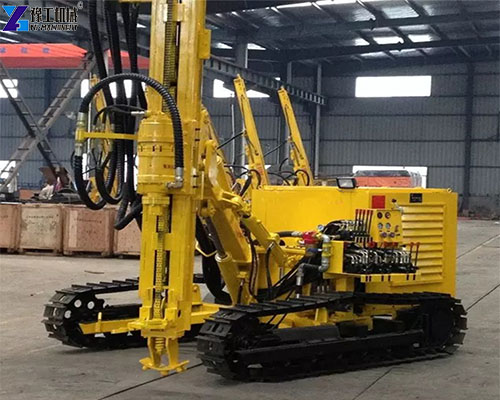
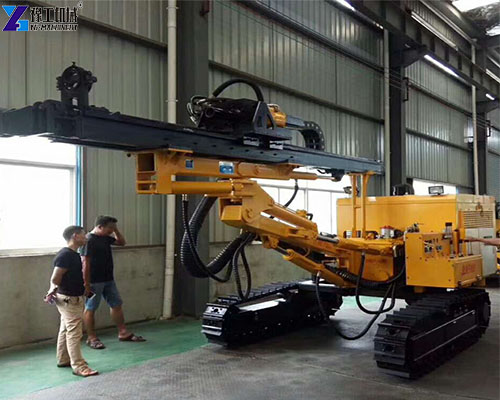
Every YGS rig is built from these main parts:
- Crawler undercarriage – Steel tracks with hydraulic drive. Provides stability and mobility on rough terrain.
- Diesel engine – Yuchai or Cummins, from 33kW to 73.5kW. Powers the hydraulic system and the air compressor (if onboard).
- Hydraulic system – Controls track movement, mast raising/lowering, and feed force.
- Drill mast – Telescopic or single section. Holds the drill rod and guides the hammer.
- Rotary head – Turns the drill rod at a controlled speed.
- Down the hole hammer – The actual impact tool. Powered by compressed air from an external compressor (or built‑in, depending on configuration).
- Control panel – Simple levers and gauges for feed, rotation, and track movement.
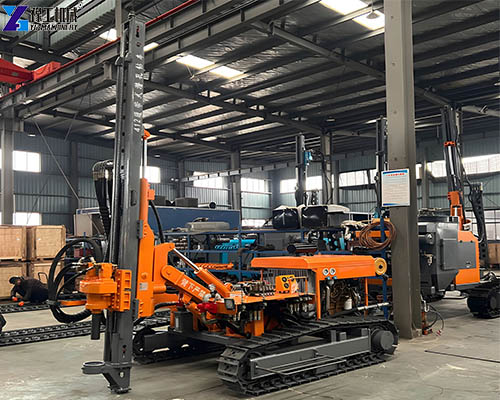
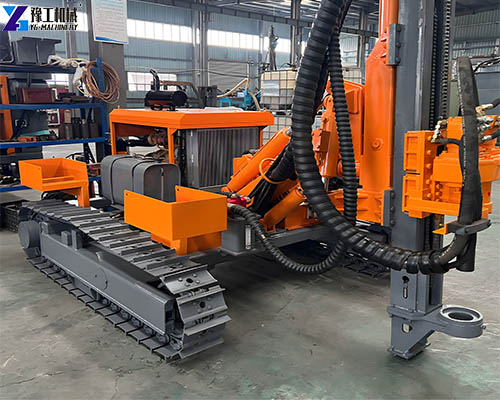
How Does A Down The Hole Drilling Rig Work?
Step 1 – Compressed air flows. An external air compressor sends high‑pressure air down the drill pipe to the hammer.
Step 2 – Hammer strikes. The air forces a piston inside the hammer to hit the drill bit hundreds of times per minute. Each strike chips the rock.
Step 3 – Rotation turns the bit. The rotary head slowly spins the whole drill string. This ensures the bit contacts fresh rock with every blow.
Step 4 – Air lifts cuttings. The same compressed air that powers the hammer flows out through holes in the bit, blowing rock dust and chips up the annulus (between the pipe and the hole wall). The hole stays clean.
The operator lowers the mast, sets the angle (0‑90° for most models), and starts drilling. When the hole reaches target depth, retract the rod, move to the next location, and repeat.
Where Can You Use A Down Hole Drilling Rig?
Typical applications include:
- Quarry blasting – Granite, limestone, marble, sandstone. Drill production holes for explosives.
- Construction foundation – Rock socket piles, anchor holes for retaining walls.
- Water well drilling – In hard rock formations, where mud rotary is slow.
- Geotechnical exploration – Taking core samples or installing monitoring instruments.
- Road and tunnel construction – Drainage holes, slope stabilization bolts.
The YGS153 (lightest) is good for small quarries and tight mountain roads. The YGS350 (heaviest) is built for large mines and continuous duty.
Choose Your YGS Down The Hole Drilling Rig
If you drill rock regularly, a down hole drilling equipment will outperform any top hammer drill in speed, hole quality, and maintenance cost. The YGS series gives you five well‑balanced models: from the nimble YGS153 to the heavy‑duty YGS350. All feature crawler tracks, hydraulic controls, and proven Yuchai or Cummins power.
Contact YG with your rock type, required hole diameter, and average depth. They will recommend the right rig and support you with spare parts and technical advice.
Frequently Asked Questions From Buyers
Yes. The YGS rigs do not have onboard compressors. You need an external diesel‑driven screw compressor delivering at least 150‑300 cfm at 150‑250 psi. YG can supply matching compressors.
Yes. The mast adjusts from 0° (vertical) to 90° (horizontal). The YGS180 reaches 3.6m horizontally – great for undercutting slopes.
The YGS153 – only 3.8T fits in a small container, drills 83‑130mm holes. Enough for most foundation and small quarry jobs. The 70L fuel tank runs for a full day.