Are you losing money on every large concrete flooring project? If your crew still levels warehouse slabs and factory floors using traditional methods, the answer is likely yes.
A standard industrial floor project spanning 6,900 square meters requires at least six to eight workers under conventional manual methods. They pull string lines, set dozens of reference points, manually strike off the concrete, and pray the two-meter straightedge doesn‘t reveal unacceptable dips. Each extra reference point introduces another opportunity for cumulative error. The result is often an average floor flatness of plus or minus 8 millimeters. If the client rejects the work, you tear out the slab or perform costly remedial grinding. Either way, you lose both time and profit.
But what if you could cut labor costs by 60 percent, more than double your daily production, and hit millimeter-level tolerances on every single pour? That is precisely what switching to a concrete laser screed delivers. And for contractors who demand precision without sacrificing maneuverability, the lightweight laser guided concrete screed has become the go-to solution.
Whether you are bidding on a 10,000 square meter logistics center or need a reliable concrete leveling machine for a series of smaller commercial slabs, understanding the advantages of modern laser screed technology will change how you estimate, bid, and complete projects. Below, we break down exactly how a laser guided concrete screed works, what it can do for your bottom line, and how to choose the right model for your fleet.
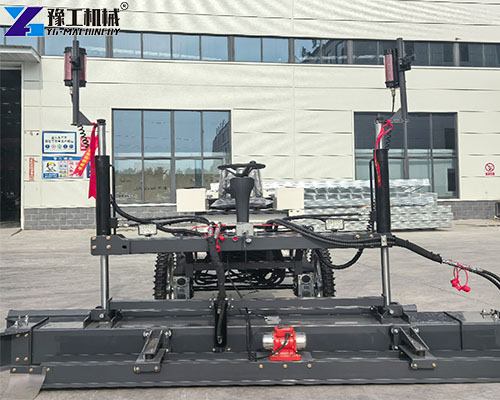
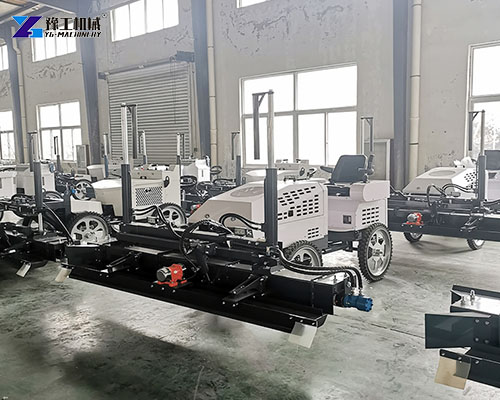
What Exactly Is A Lightweight Laser Guided Concrete Screed?
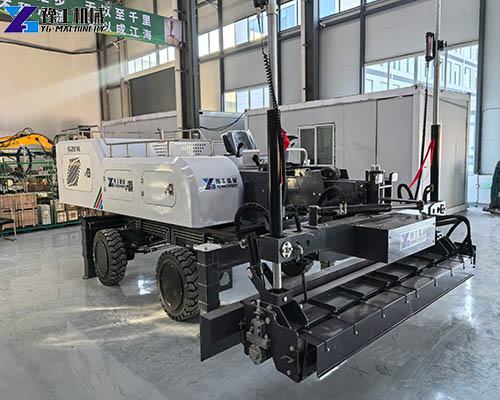
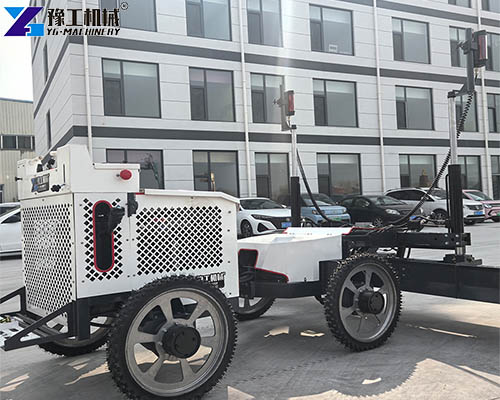
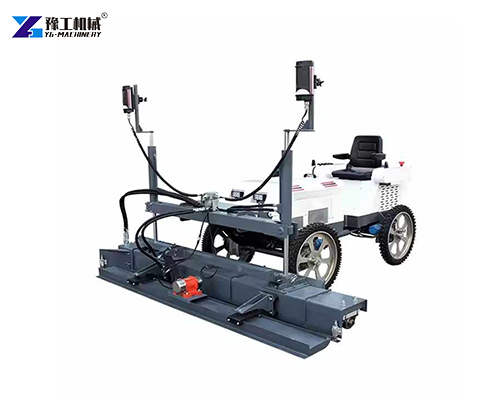
Put simply, a lightweight laser guided concrete screed replaces string lines and hand-operated strike-off boards with a fully automated laser-controlled leveling system. A rotating laser transmitter is set up on a tripod at the job site, projecting a 360-degree horizontal reference plane across the entire pour area. High-precision laser receivers mounted on the screed head continuously detect the laser signal and feed real-time data into the machine‘s microcomputer control system
As the laser guided concrete screed moves across the wet concrete, the control system automatically raises or lowers the screed head to maintain perfect alignment with the laser reference plane. Integrated hydraulic vibrators compact the concrete at up to 4,000 cycles per minute, ensuring full consolidation while the screed head levels the surface in a single pass.
The result is a floor that meets tight flatness specifications with minimal labor input—an outcome that manual processes simply cannot match.
YG Lightweight Laser Guided Concrete Screed Models And Specifications
Choosing the right laser guided concrete screed depends on your typical project size, site access conditions, and budget. YG Machinery manufactures a full range of laser leveling equipment from compact walk-behind units to larger heavy-duty configurations. Below are the specifications for YG‘s most widely used lightweight laser screed models:
| Model | YGJX31 | YGJX32 | YGJX33 | YGJX34 |
| Engine | ||||
| Model | Generator set | GX390 Electric start | GX390 Electric start | GX390 Electric start |
| Power | 2.0kW | 13hp/3600rpm | 13hp/3600rpm | 13hp/3600rpm |
| Fuel tank (L) | 14.5 | 6.5 | 6.5 | 6.5 |
| Running device | ||||
| Drive | Motor | Hydraulic motor | Hydraulic motor | Hydraulic motor |
| Running mode | Infinitely variable speed | Handle control, stepless speed | Handle control, stepless speed | Handle control, stepless speed |
| Running speed(m/min) | 0-36 | 0-45 | 0-65 | 0-45 |
| Suggest working speed(m/min) | 5 | 5 | 5 | 5 |
| Screed head | ||||
| Type | Self-leveling | Electric control, self-leveling | Self-leveling | Hydraulic control, self-leveling |
| Width | 2500mm | 2500mm | 2500mm | 2500mm |
| Exciting force | 500N | 500N | 500N | 500N |
| Vibration frequency | 50Hz | 50Hz | 50Hz | 50Hz |
| Laser control system | ||||
| Control type | Microcomputer laser scan | Microcomputer laser scan | Microcomputer laser scan | Microcomputer control |
| Operation mode | Walk-behind | Walk-behind | Walk-behind | Walk-behind |
| Forward and reverse | Handgrip control, stepless speed-walking | Hydraulic control | Handgrip control, stepless speed-walking | Hydraulic control |
| Size and weight | ||||
| Working size(mm) | 2758*2622*1980 | 2740×2659×1980 | 2578×2643×1980 | 2780*2622*1980 |
| Weight(kg) | 295 | 365 | 380 | 410 |
How A Laser Guided Concrete Screed Solves Your Biggest Flooring Problems?
Problem One: Low Productivity That Kills Your Margins
Under the traditional method, a crew of six to eight people can place and finish roughly 500 to 800 square meters of concrete floor per day. That pace rarely satisfies the aggressive schedules demanded by warehouse and industrial projects.
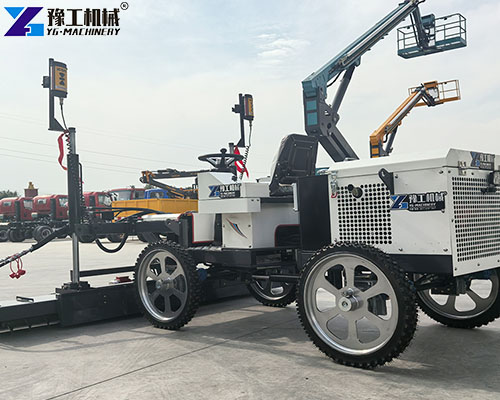
A lightweight laser guided concrete screed changes the math completely. YG‘s four-wheel walk-behind laser screed models feature working widths of 2,500 millimeters and running speeds adjustable up to 65 meters per minute, with a suggested working speed of 5 meters per minute for optimal flatness. That translates to a daily output of 2,000 to 3,000 square meters per machine.
In documented projects, laser guided concrete screeds have completed 3,600 square meters of pours in just two days, reducing total construction time by nearly 50 percent compared to conventional methods.
Problem Two: Poor Flatness Leads to Costly Rejection
Traditional leveling methods rely on dozens of string-line reference points. Each new point introduces a fresh opportunity for error. The gaps between reference points frequently produce localized high spots or low dips that the two-meter straightedge ruthlessly exposes.
A laser guided concrete screed eliminates this problem. The entire floor slab is referenced to a single, stable laser plane projected from one or two transmitter setups. YG‘s laser screed achieves leveling accuracy errors controlled within 3 millimeters, far superior to traditional construction methods that can deviate by 8 millimeters or more. Microcomputer laser scanning technology continuously monitors the screed head position and makes instantaneous corrections. Poured once. Leveled correctly and approved on the first inspection.
Problem Three: Soaring Labor Costs and Skilled Worker Shortages
The construction industry faces a persistent shortage of skilled concrete finishers. Those who remain command premium wages. A conventional floor crew requires six to eight workers: pump operators, spreaders, vibrators, strike-off guys, and trowel finishers.
A lightweight laser guided concrete screed changes the labor equation. One or two operators can run the machine and achieve better results than a full traditional crew. YG‘s walk-behind models require a single operator to control forward and reverse movement, speed, and leveling parameters—all from the handle grips. Labor input drops by 50 to 60 percent. Labor costs follow. The same crew can handle more square footage with less fatigue, higher morale, and better safety.
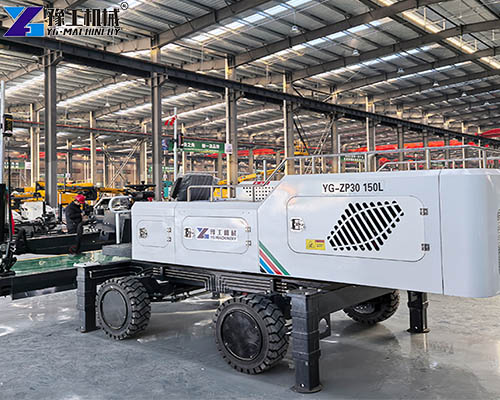
Where Contractors Use Lightweight Laser Guided Concrete Screeds Today?
Laser screed technology is indispensable for any project requiring large floor areas with tight flatness specifications. Common applications include:
Industrial Plants and Factories: Automated production lines and heavy machinery demand floors with exceptional flatness
Logistics Warehouses: Forklift traffic at high speeds requires level surfaces for safety and equipment longevity
Airport Runways and Hangars: Large aircraft impose extreme loads that only precision-leveled slabs can withstand
Commercial Buildings: Shopping malls, parking garages, and big-box retail stores demand aesthetic and durable floors
Agricultural Facilities: Dairies and livestock barns benefit from easy-to-clean, sloped floor surfaces created by laser screeds with dual-slope capability.
If you pour large-footprint ground slabs, a laser guided concrete screed belongs in your equipment lineup.
Is A Lightweight Laser Guided Concrete Screed Worth The Investment?
If you regularly pour industrial floor slabs larger than 2,000 square meters, if your clients specify FF/FL numbers that exceed manual capabilities, and if you are tired of high labor costs consuming your margins, then a laser guided concrete screed is not a luxury. It is a business necessity.
The numbers speak for themselves: three times the production speed, half the labor cost, and millimeter-level flatness measured by a two-meter straightedge instead of a tape measure. One machine delivered by YG can replace three to five workers while producing better, more consistent floors on every pour.
Yes, the upfront investment is significant. But most contractors recover the full equipment cost within one or two large projects through reduced labor expenses, faster completion schedules, and the elimination of costly rework. From there, every additional job goes straight to the bottom line.
If you‘re ready to stop losing money on large concrete floors and start bidding more competitive, more profitable projects, then YG‘s full range of lightweight laser guided concrete screeds is your ideal solution. YG provides not only high-quality machinery but also competitive solutions that drive sustained growth for your business. Contact us now to request the latest product catalog, discuss your specific application needs, and learn how the right laser screed can transform your concrete flooring operation.
Contact YG Machinery today:
WhatsApp/WeChat/Skype/Phone:+86 159 3715 3321