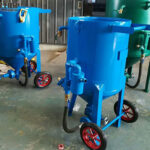
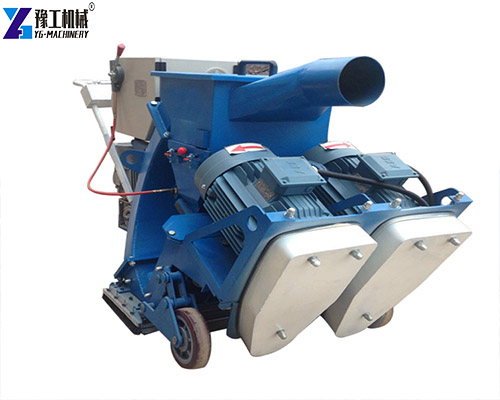
Mobile abrasive blasters are portable surface treatment tools that propel abrasive media at high velocity to remove rust, paint, corrosion, and contaminants from metal, wood, concrete, and other surfaces. The current global boom in infrastructure maintenance, automotive restoration, shipyard repair, and industrial coating removal has driven a surge in demand for compact, job-site-ready blasting equipment.
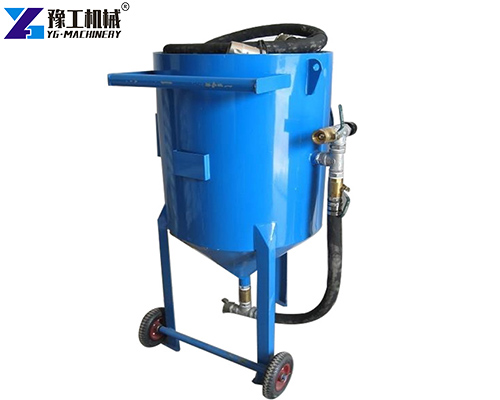
YG Machinery has launched seven mobile abrasive blaster models with tank diameters from 400mm to 1000mm. They feature high-pressure operation, adjustable air consumption, interchangeable nozzles, and durable Q235B carbon steel construction. They offer extremely high cleaning efficiency, significant labor cost savings compared to hand sanding, corrosion-resistant tanks with 5-8mm plate thickness, and compatibility with multiple abrasives. They are suitable for surface preparation tasks of different scales – from small garage workshops to large shipyards and pipeline projects – and are a highly reliable choice for contractors seeking both portability and productivity.
But with seven tank sizes and many manual sanding or stationary cabinet methods still in use, how do you choose the right one? In this head-to-head comparison, we pit YG Machinery’s seven mobile abrasive blasters against each other and against manual surface preparation, focusing on tank capacity, cleaning efficiency per hour, portability, and project suitability.
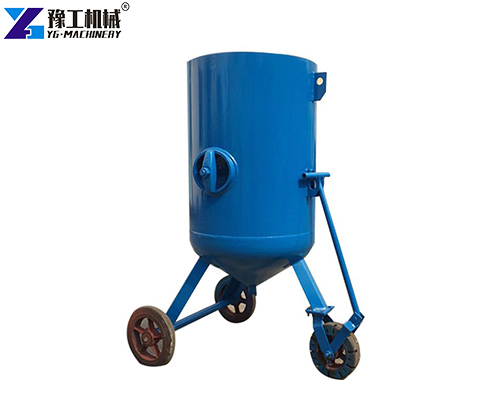
Technical Specifications Of YG Mobile Abrasive Blaster Models
All seven models are dry sandblasting machines designed for portable, on-site rust and paint removal. Below are the core parameters.
| Diameter (mm) | Height (mm) | Volume (m³) | Pressure (MPa) | Efficient Area (m²/h) | Air Consumption (m³/min) | Plate Thickness (mm) |
| 400 | 1100 | 0.15 | 0.5-0.8 | 3-7 | 5 | |
| 500 | 1150 | 0.2 | 0.5-0.8 | 3-7 | 5 | |
| 600 | 1200 | 0.3 | 0.5-0.8 | 5-10 | 3-7 | 6 |
| 700 | 1350 | 0.4 | 0.5-0.8 | 6-11 | 3-7 | 6 |
| 800 | 1900 | 0.8 | 0.5-0.8 | 10-12 | 3-7 | 6 |
| 900 | 2000 | 0.8 | 0.5-0.8 | 10-20 | 3-7 | 8 |
| 1000 | 2000 | 1.0 | 0.5-0.8 | 10-30 | 3-7 | 8 |
The pressure range and air consumption are consistent across the lineup. Larger tanks hold more abrasive media, extending continuous blasting time without refilling. Cleaning efficiency (m²/h) depends on workpiece complexity – flat plates yield higher efficiency, while irregular shapes reduce output.
Comparison Between YG Mobile Blasters Vs Manual Sanding And Stationary
Many workshops still use manual sanding because of the very low upfront cost. Stationary blasting cabinets offer better efficiency but cannot be moved to large workpieces. Let us break down four critical dimensions across YG’s lineup and compare them to these alternatives.
Cleaning Speed and Labor Cost: Manual sanding removes rust at roughly 1-2 m² per hour per worker, with high physical effort and inconsistent results. A single YG mobile abrasive blaster achieves 10-30 m² per hour (depending on model and workpiece). The manufacturer states that one machine equals the workload of 50-80 skilled manual workers. For a 100 m² steel bridge girder, manual sanding takes 50-100 labor hours; a YG-1000 model finishes in 3-10 hours. This directly cuts labor costs by 80-95%.
Portability and On-Site Flexibility: Stationary blasting cabinets cannot be moved to large objects like ship hulls, storage tanks, or building facades. YG’s mobile units have small footprints and can be wheeled to any location. The 400mm diameter model stands 1100mm tall – fits through standard doorways. The 1000mm model requires more space but still rolls on casters. You can blast on-site without moving heavy workpieces.
Tank Capacity and Continuous Operation: A 400mm tank holds 0.15m³ of abrasive – enough for 15-20 minutes of continuous blasting on small parts. A 1000mm tank holds 1.0m³ – up to 2 hours of blasting before refill. This matters for large projects: fewer refill stops mean higher productivity. Manual sanding has no “refill” downtime but is painfully slow. The larger YG models (800-1000mm) are recommended for full-day production runs.
Abrasive Versatility and Surface Quality: Manual sanding can only use sandpaper or wire brushes, is limited to specific contours, and easily misses tight corners. YG’s mobile blaster accepts multiple media: glass beads for satin finish on metal, aluminum oxide for aggressive rust removal, walnut shells for soft metals, crushed glass for epoxy, and thick coatings. By changing nozzles and adjusting pressure, you go from delicate cleaning to heavy stripping without changing machines.
Core Advantages Of YG’s Mobile Abrasive Blasters Over Manual And Stationary Methods
Why do professional surface treatment contractors switch to YG’s handheld abrasive blaster? Four unbeatable strengths.
High Precision: The adjustable pressure and focused nozzle allow you to reach tiny, hidden burrs and corrosion inside complex shapes. Unlike manual sanding, the abrasive stream conforms to irregular surfaces, leaving no sharp edges or under-cutting. Workpiece surfaces are not damaged, which improves both appearance and service life.
Easy Operation: Ordinary workers can operate the machine proficiently after just 30 minutes of training. The advanced automatic control system prevents misoperation (e.g., accidental trigger locks, pressure regulators). Manual sanding requires skilled labor and still produces inconsistent results. Stationary cabinets need operator training for part positioning.
Small Floor Space: A single mobile blaster with its auxiliary equipment fits into a 10 m² area. You can set up a complete blasting station in a corner of your workshop or move it to a job site in a pickup truck. Stationary cabinets typically require 20-30 m² plus dedicated ventilation.
Compatible with Multiple Abrasives: Switch media in minutes. Glass beads for auto restoration. Aluminum oxide for heavy industrial cleaning. Walnut shells for aircraft parts or aluminum wheels. Crushed glass for marine coatings and tank linings. No other single tool offers this range.
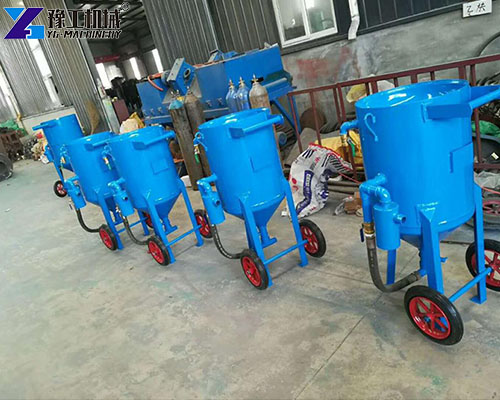
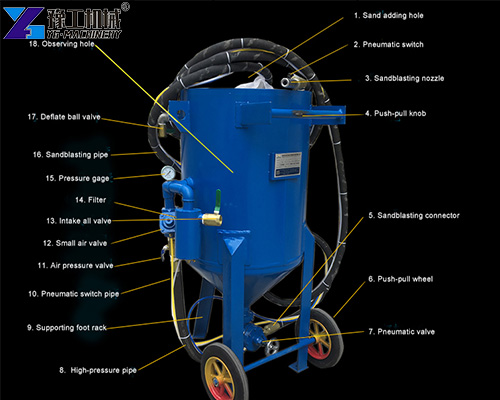
Which Mobile Abrasive Blaster Model Should You Choose?
Based on our comparison, here is the straightforward advice.
Choose 400mm or 500mm diameter if: You work on small parts. You have limited space and need ultra-portability. Tank volume 0.15-0.2m³ gives 15-25 minutes of blasting per fill. Plate thickness 5mm is adequate for light use. Ideal for hobbyists, small repair shops, or mobile detailers.
Choose 600mm or 700mm diameter if: You handle medium-sized projects (metal furniture, agricultural equipment, construction machinery). Volume 0.3-0.4m³ provides 30-45 minutes of runtime. Efficiency 5-11 m²/h. Most popular models for general contractors who need a balance of portability and capacity.
Choose 800mm diameter if: You work on large flat surfaces. Volume 0.8m³ gives up to 1 hour of continuous blasting. Efficiency 10-12 m²/h. Plate thickness of 6mm ensures durability. Best for medium-volume industrial work.
Choose 900mm or 1000mm diameter if: You run a full-time blasting business with daily output targets. Volume 0.8-1.0m³. Efficiency up to 30 m²/h on flat plates. Plate thickness 8mm on 900-1000mm models for heavy-duty longevity. These are the most productive models – highest output per operator. Ideal for shipyards, pipeline contractors, and large restoration firms.
Avoid manual sanding if: Your project exceeds 10 m², or you need a consistent surface profile for coating adhesion. The labor cost and time are simply not competitive. Avoid stationary cabinets if your workpieces are too large to fit inside.
Choose A Suitable Mobile Sandblasting Machine Manufacturer
Stop wasting hours with hand sanding or struggling to move heavy parts to a stationary cabinet. YG Machinery has supplied mobile abrasive blasters to surface treatment contractors in over 40 countries. Our team provides 24/7 technical support, nozzle selection guidance, and abrasive media recommendations.
Contact us now for a free project consultation, a customized quote based on your typical workpiece size, or a live video demonstration. Take the first step toward faster, cleaner, and more professional surface preparation.