You have a road marking job. The contract asks for bright, reflective lines that last for years. Cold paint fades fast. Tape peels off. What is the professional solution? A thermoplastic line striping machine. Thermoplastic material is a powder that you heat to 180‑210°C until it melts into a thick liquid. Then you apply it to the road. When it cools, it forms a hard, durable line that reflects light at night. One application can last three to five years – much longer than paint.
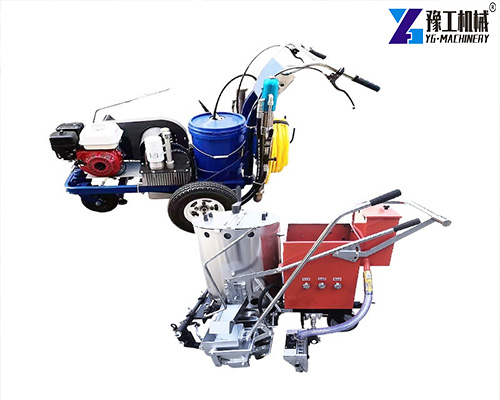
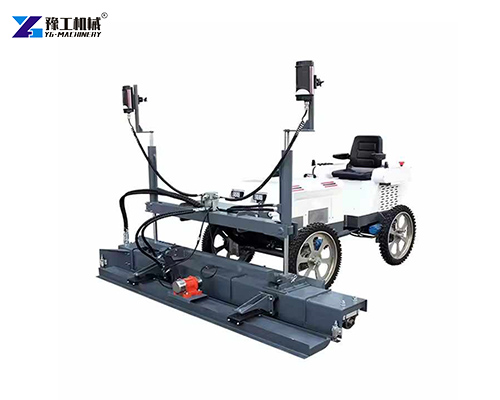
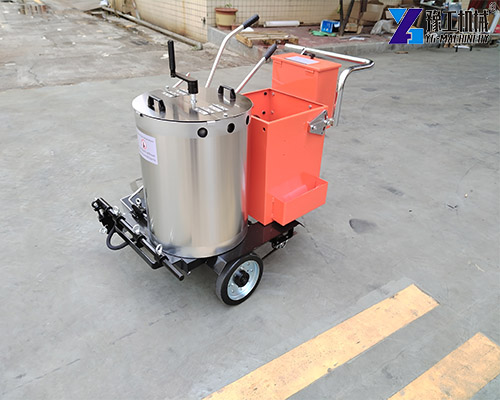
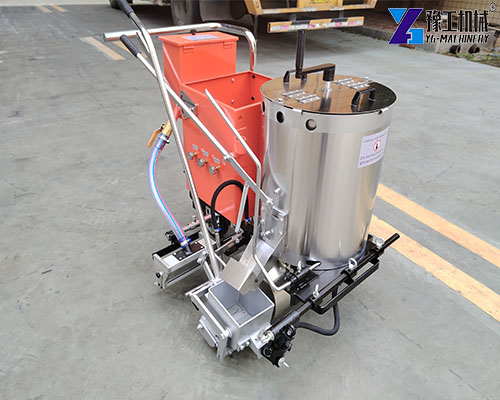
YG offers two main types of thermoplastic line-striping machines: the CK360/CK380 hand-push model for standard flat lines and the CKM oscillating (vibratory) model for raised rumble strips. The hand-push model has a 100kg double‑wall stainless-steel kettle, an adjustable glass-bead spreader, and interchangeable line dies from 50mm to 450mm wide. The oscillating model uses a Honda LP gas engine, automatic hydraulic drive, and can create raised bumps 3‑5mm high for warning lines.
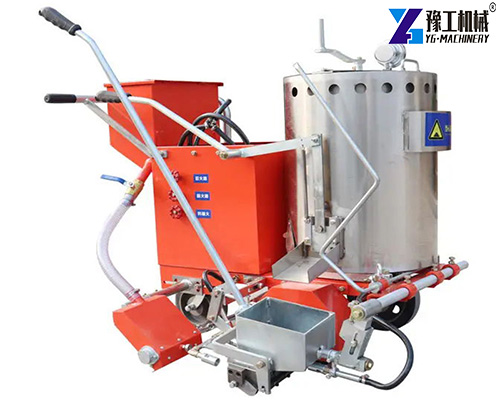
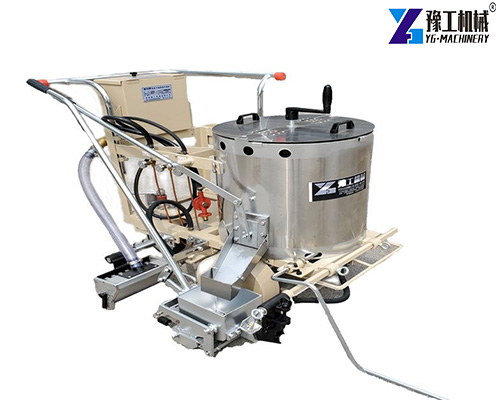
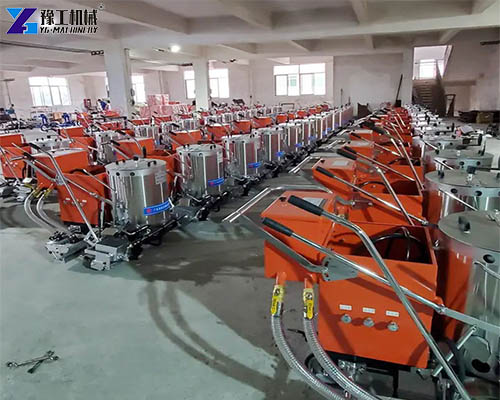
YG Hand Push Thermoplastic Line Striping Machine
| Model | YG-CK360S | YG-CK380S |
| Thermoplastic Tank | synchronous clutch spreading, equipped with a speed-adjustable gear shifting device, single/double spreading can be selected according to needs, 50-200mm | synchronous clutch spreading, equipped with a speed-adjustable gear shifting device, single/double spreading can be selected according to needs, 50-200mm |
| Glass Bead Container | 10kg/box | 10kg/box |
| Adjustable glass bead spreader | Ensure the machine is moving in a straight line or turning freely on the curved road | Ensure the machine is moving in a straight line or turning freely on a curved road |
| Rear Wheel Directional Device | 100kg, double stainless steel heating insulation barrels, plug-in manual mixer devices, and removable devices | Ensure the machine is moving in a straight line or turning freely on a curved road |
| Brake | Using a drum brake, you can adjust the brake tension | Using a drum brake, you can adjust the brake tension |
| Marking width | Standard 150mm marking bucket 100mm、150mm、200mm、250mm、300mm、400mm、450mm (at customers’ option) | Standard 150mm marking bucket 100mm、150mm、200mm、250mm、300mm、400mm、450mm (at customers’ option) |
| Battery Capacity | 15AH | 15AH |
| Battery Voltage | 48V lithium battery | 48V lithium battery |
| Driver Speed | 1-8km/hour | 1-8km/hour |
| Working Duration | The machine can mark road lines24 hours after charging the battery, 5 hours | Ensure the machine is moving in a straight line or turning freely on a curved road |
| Dimensions | 1210X970X1070mm | 1200X970X1100mm |
| Net weight | 130kg | 100kg, double stainless steel heating insulation barrels, plug-in manual mixer devices, and removable devices |
What does the positioning guide do? It is a small wheel at the back that you can lock straight for long, straight lines or unlock to let the machine turn freely around curves.
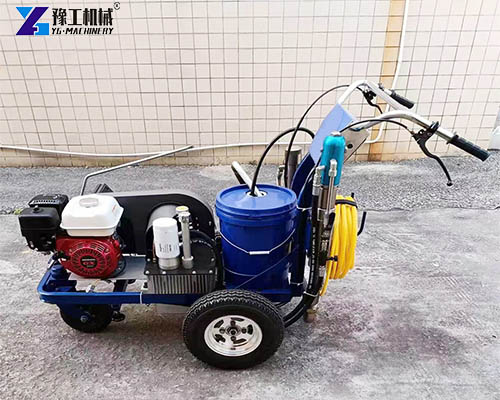
YG Oscillating (Vibratory) Thermoplastic Line Marking Machine
This is a special machine for raised rumble strips – the bumpy lines that warn drivers to slow down or stay in lane.
| Specification | Parameters |
| Overall Dimension | 1360×980×1250mm |
| Net Weight | 265KG |
| Paint Bucket Capacity | 120KG (60L) |
| Glass Bead Hopper Capacity | 10KG |
| Engine Type | Honda OHV 4-stroke air-cooled liquefied gas engine |
| Engine Displacement & Power | 163CC, 5.5HP |
| Fuel Type | LPG Liquefied Petroleum Gas |
| Driving Mode | Automatic hydraulic stepless speed regulation |
| Travel Speed | Max forward speed: 4000m/hMax reverse speed: 3200m/h |
| Max Climbing Gradient | 15° |
| Raised Line Height | 3-5mm, base line thickness adjustable by hanger |
| Marking Width | 3-5mm, base line thickness adjustable by the hanger |
What makes this machine different? It uses a German intelligent control panel and an imported air compressor to drive a pneumatic cylinder that lifts the die up and down as you move. This creates a series of raised bumps instead of a flat line. The bumps are 3‑5mm high and exactly spaced. You can also adjust the baseline thickness using the lifting frame.
The Complete Thermoplastic Marking System
Before you buy any thermoplastic road marking equipment, you need to understand the full system.
Basic equipment:
- Thermoplastic kettle (melter) – This is where you melt the powder. YG does not list a separate model number, but the hand push striper itself has a 100kg heating kettle built in. For larger jobs, you may need a separate truck‑mounted kettle.
- Thermoplastic line striping machine – The hand push unit (CK360/CK380) or the oscillating unit (CKM).
Auxiliary equipment:
- Zebra crossing striper – For wide crosswalks. (Contact YG for model.)
- Old line remover – Model CK1050 mentioned in the document. Removes old paint or thermoplastic lines before you apply new ones.
- Blower – Blows dust and loose debris off the road surface.
- Sweeper/cleaning machine – Cleans off dirt, cement residue, or old cold paint.
Why do you need all this? The road surface must be clean and dry before you apply thermoplastic. If you leave dust or old paint underneath, the new line will not stick. A good preparation machine (blower + sweeper + old line remover) is just as important as the striper itself.
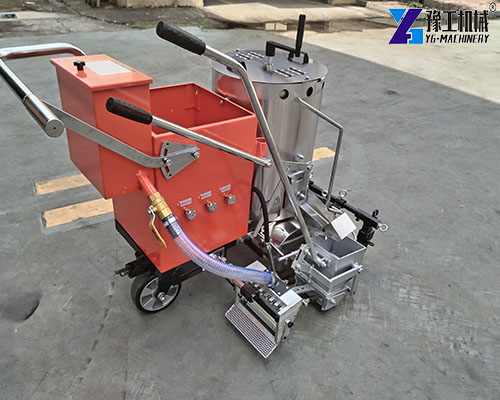
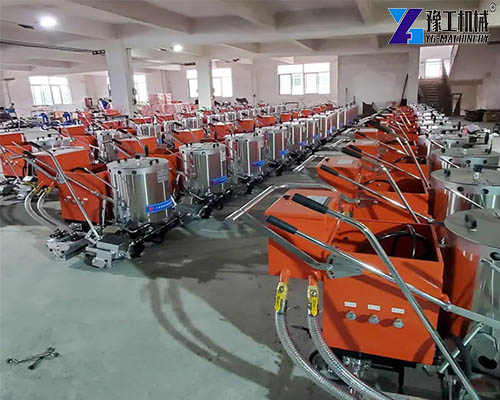
How Does The Whole Process Work?
Step 1 – Prepare the surface. Use the sweeper and blower to remove dust, dirt, and loose debris. If there are old lines, use the old line remover to grind them off. The road must be clean and dry.
Step 2 – Apply primer. Some roads need a primer coat to help the thermoplastic bond. The document gives a material ratio: for every 1 ton of thermoplastic powder, use 0.1 units of primer (about 1 barrel) and 0.3 units of glass beads (about 4 bags). But check local specifications.
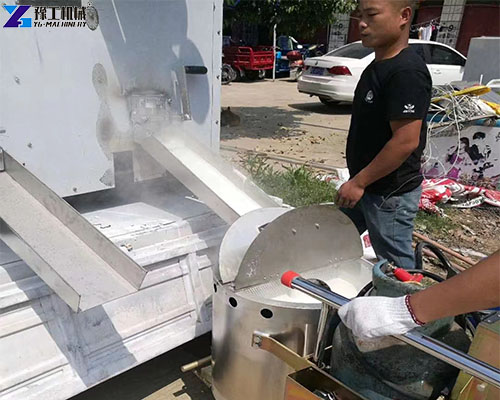
Step 3 – Melt the thermoplastic. Pour the powder into the kettle of your thermoplastic line striping machine. Heat it to 180‑210°C. Stir it until it becomes a thick, smooth liquid. The CK360/380 kettle holds 100kg of material.
Step 4 – Apply the line. Push the machine along the road. The hot liquid flows through the die (line die) onto the road surface. The die determines the line width – you can swap dies from 50mm up to 450mm. The machine spreads the material evenly, producing a line with straight edges, clean ends, and uniform thickness.
Step 5 – Add glass beads. As the hot line is laid, the built‑in glass bead spreader drops reflective beads onto the wet thermoplastic. The beads sink in about halfway. When headlights hit the line at night, the beads reflect light back to the driver (retro‑reflection). This is what makes thermoplastic lines glow at night.
Step 6 – Cool and open. The line cools in a few minutes. Then you can open the traffic road.
Work efficiency: Depending on operator skill and road conditions, one crew can mark 500‑1500 square meters per 8‑hour shift.
Frequently Asked Questions
180°C to 210°C (356°F to 410°F). The kettle has a temperature control system. Do not overheat – the material may burn or degrade.
500‑1500 square meters per 8‑hour shift. It depends on operator skill, road condition, and whether you need to remove old lines first.
For the hand pushes CK360, the melter is built into the machine. You melt the powder directly in the striper’s kettle. For very large jobs (over 2‑3 tons per day), you may want a separate truck‑mounted kettle to keep material flowing. Ask YG.
The CK360 has a rear positioning wheel that you can lock straight. You can also use a string line or a laser guide. For long highways, some users add a sight rod.
Yes. For parking lots, you often need 100mm lines and sharp curves. The CK360‘s free‑turning rear wheel makes curves easy.
Is A YG Thermoplastic Line Striping Machine Right For You?
If you do road marking work – highways, parking lots, crosswalks, airports – thermoplastic is the professional choice. It lasts 3‑5 years, reflects light at night, and withstands traffic and weather. YG offers the CK360 hand push model for flat lines (50‑450mm wide, 100kg kettle, glass bead spreader) and the CKM oscillating model for raised rumble strips (3‑5mm high, Honda LPG engine, hydraulic drive). Both machines are backed by YG‘s experience in road construction equipment.
Contact YG directly with your typical line width, daily square meter requirement, and whether you need rumble strips. They will recommend the right model and provide a quote.