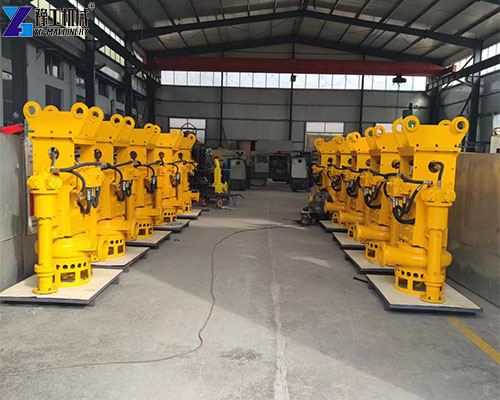
You are working on a dredging project – clearing silt from a river, pumping sand from a lake, or removing sludge from a tailings pond. The water is deep, the sediment is loose, and a standard excavator bucket just stirs up mud without picking anything up. You need to pump the material out, not scoop it. What if your excavator itself could do the pumping?
That is exactly what an excavator dredge pump does. It is a hydraulic pump attachment that mounts on your excavator arm. The excavator’s hydraulic system powers the pump. You lower it into the water or slurry, and it sucks up sand, silt, mud, and even gravel – then pumps it through a discharge pipe to a disposal area. No separate dredge boat. No electric power lines. Just your excavator and this attachment.
YG Machinery offers nine models of excavator mounted dredge pumps. Flow rates range from 150 to 500 m³/h. Lift heights from 10 to 40 meters. They fit excavators from 10 tons up to 40 tons. The pumps feature a bottom agitator to loosen settled material, optional side cutters to break up compacted layers, and high-chrome alloy wear parts for long life.
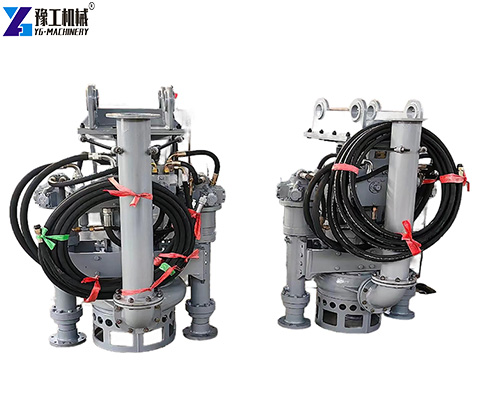

YG Excavator Dredge Pump – Key Specifications
Here are the complete parameters for all nine models. Choose based on your required flow rate, lift height, and excavator size.
| Serial No. | Model | Flow m3/h | Lift(m) | Matching Agitator | Stirrer Torque | Excavator Tonnage |
| 1 | YG200-15 | 200 | 15 | 5.5KW | 1556 | 10T-20T |
| 2 | YG150-30 | 150 | 30 | |||
| 3 | YG300-20 | 300 | 20 | |||
| 4 | YG400-10 | 400 | 10 | 7.5KW | 1946 | 20T-30T |
| 5 | YG500-15 | 500 | 15 | |||
| 6 | YG250-35 | 250 | 35 | |||
| 7 | YG300-30 | 300 | 30 | 15KW | 2433 | 30T-40T |
| 8 | YG400-30 | 400 | 30 | |||
| 9 | YG400-40 | 400 | 40 |
How Does an Excavator Dredge Pump Work?
Step 1 – Hydraulic power. The excavator’s hydraulic system sends pressurized oil to the pump’s hydraulic motor. The motor converts hydraulic energy into mechanical rotation.
Step 2 – Agitation. The pump has a bottom agitator that spins and loosens settled sand, silt, or mud. Optional side cutters on both sides break up compacted layers, preventing large solids from blocking the pump. This allows the pump to handle material with up to 70% solid concentration.
Step 3 – Suction and pumping. The rotating impeller creates suction that draws the slurry (water + solids) into the pump. The impeller then pushes the slurry through the discharge pipe at high velocity.
Step 4 – Discharge. The slurry travels through the discharge pipe (connected to the pump outlet) to a disposal area, settling pond, or dewatering site. The pump can move material over long distances depending on the flow and lift.
The pump handles solid particles up to 50mm in diameter – that includes sand, gravel, and small stones.
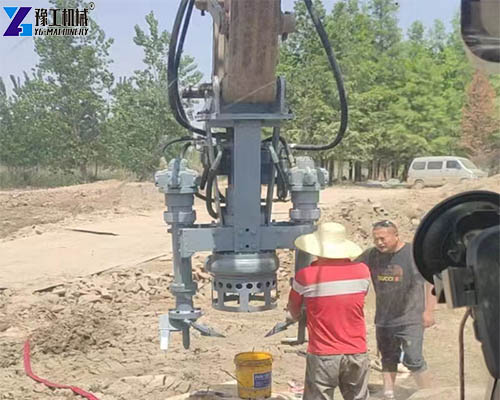

Where Can You Use an Excavator Dredge Attachment?
Waterway dredging – Rivers, canals, lakes, and ports. Remove silt and sediment to maintain navigable depth.
Mining and tailings – Pumping tailings slurry from mineral processing plants. Reclaiming sand from tailings ponds.
Construction dewatering – Removing water and mud from excavation sites, bridge foundations, and underground construction.
Flood relief and emergency – Pumping floodwater and clearing disaster debris after storms.
Land reclamation – Pumping sand and fill material for coastal development and land reclamation projects.
Sewer and drainage – Cleaning out municipal sewers, storm drains, and treatment plant settling tanks.
Agriculture – Clearing irrigation canals and drainage ditches.
Offshore and coastal – Beach nourishment, port maintenance, and shallow water dredging.
Advantages of a Hydraulic Dredge Pump Over Electric Pumps
| Feature | Hydraulic Pump (YG) | Electric Submersible Pump |
| Power source | Excavator hydraulic system – no external power | Requires electrical connection or generator |
| Mobility | Moves with excavator – free to roam | Fixed position – needs crane to move |
| Overload protection | Automatic – hydraulics stall safely | Burns out if overloaded |
| Speed control | Infinitely variable | Fixed speed |
| Remote operation | Works anywhere | Limited by cable length |
| Solid handling | Up to 70% concentration, 50mm particles | Lower concentration capability |
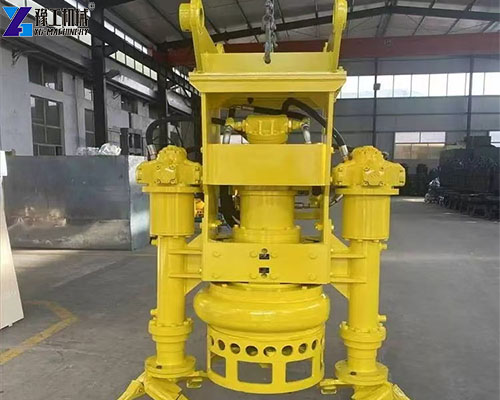

Key Features of YG Excavator Mounted Dredge Pumps
- High solid concentration. Can handle slurry with up to 70% solids by weight. That is very thick – almost like wet concrete.
- Large particle handling. Solids up to 50mm in diameter pass through without clogging.
- Agitator + side cutters. The bottom agitator loosens settled material. Optional side cutters (two sides) break up compacted layers, preventing large solids from blocking the pump and achieving automatic digging and suction.
- High-chrome alloy wear parts. The pump casing, impeller, liner, and agitator are made of high-chrome alloy (高铬合金). Resists abrasion from sand and gravel. Custom materials available on request.
- Unique seal design. Reduces the need for frequent mechanical seal replacement. Less maintenance, higher uptime.
- Hydraulic motor options. Uses quantitative plunger motors or five-star motors – advanced design, high efficiency, stable operation. Choose different displacement motors for different conditions.
- Free movement. Mounts on your excavator. Go anywhere the excavator can reach.
- No electric power needed. Powered by the excavator’s hydraulic system. Perfect for remote sites.
Installation Steps
Step 1 – Check hydraulic lines. Ensure your excavator has hydraulic piping installed and clear.
Step 2 – Remove the bucket. Take the bucket off the excavator arm.
Step 3 – Mount the pump. Connect the hydraulic dredge pump to the excavator arm using the mounting plate.
Step 4 – Connect oil lines. Connect the pressure line, return line, and drain line. Important: The drain line must go directly back to the hydraulic tank – do not connect it to the return line.
Step 5 – Install the cutters. Attach the side cutters. Make sure they are not reversed.
Step 6 – Test run. Start the pump. If the cutters are running backward, swap the two cutter connections.
Conclusion – Turn Your Excavator into a Dredging Machine
An excavator dredge pump is one of the most versatile attachments you can add to your fleet. It turns your excavator into a mobile dredging unit – capable of pumping sand, silt, mud, and slurry from any water body the machine can reach. No separate dredge boat. No electric power. Just your excavator and this attachment. YG offers nine models covering flow rates from 150 to 500 m³/h and lift heights from 10 to 40 meters. They fit 10-40 ton excavators. The pumps feature bottom agitators, optional side cutters, high-chrome alloy wear parts, and unique seals for long life. The hydraulic drive provides variable speed and automatic overload protection – no burned-out motors.
Applications include river and port dredging, tailings pumping, construction dewatering, flood relief, sewer cleaning, and land reclamation. If you work near water, this is the attachment you need.
YG Machinery also offers other excavator attachments: breakers, grapples, shears, and crusher buckets. Contact YG with your excavator make, model, and typical material. They will recommend the right excavator mounted dredge pump and provide a quote. Start pumping – start working.