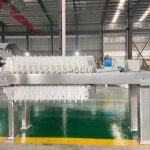
A filter press for sludge dewatering squeezes liquid out of slurry and leaves a firm solid cake behind. Because it works under steady pressure, it handles solid-liquid separation jobs that simple settling cannot finish. If you need a YG dewatering filter press that scales from a 15 m² jack-clamped unit to a 500 m² automatic machine, this article walks you through the working principle, key parameters, typical uses, and main advantages. Finally, it answers the questions buyers ask most often.
Find The Right Solution For Your Job
How Does a Filter Press For Sludge Dewatering Work?
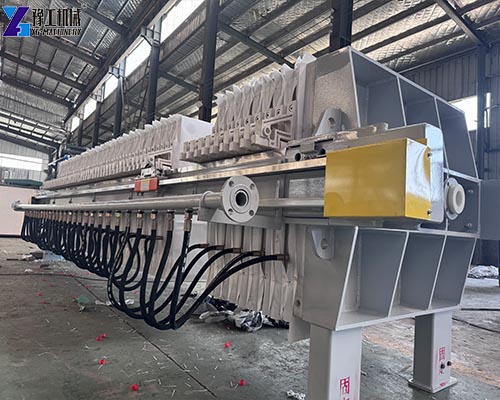
A filter press is a common piece of solid-liquid separation equipment. It uses filter cloth to trap solid particles inside a clamped filter chamber. A feed pump then adds pressure, and the liquid flows out through the discharge valve.
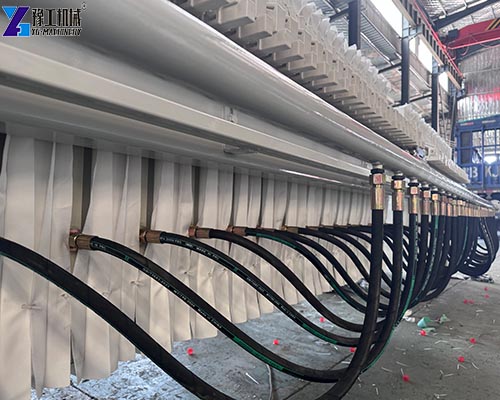
Inside the machine, slurry enters each chamber through the feed hole. Solid particles are larger than the pores in the cloth, so they stay in the chamber and build up as filter cake. The liquid passes through the cloth and leaves from the outlet. You can choose between two discharge styles. With open flow, each plate has its own outlet and tap, so the filtrate drains straight from every plate. With closed flow, the filtrate from all plates joins together and leaves the machine through one pipe.
A diaphragm filter press goes one step further. It replaces some ordinary plates with diaphragm plates and places them between the standard plates. After filtration, the system pumps water or air into the diaphragm plates. The plates swell, squeeze the cake, and lower its moisture content.
The machine has three main sections:
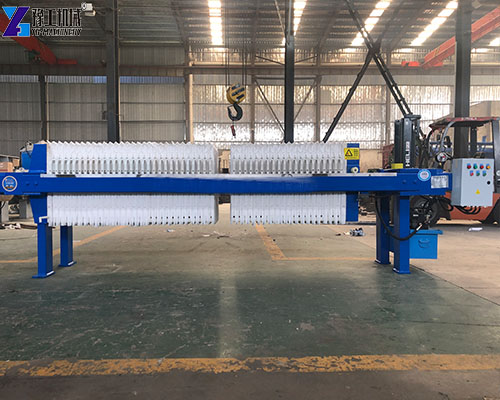
- Main frame: The thrust plate, pressing plate, clamping frame, and main beams form the base of the machine. During operation, the piston rod of the oil cylinder pushes the pressing plate against the filter plates and cloth, so the chamber stays sealed under pressure.
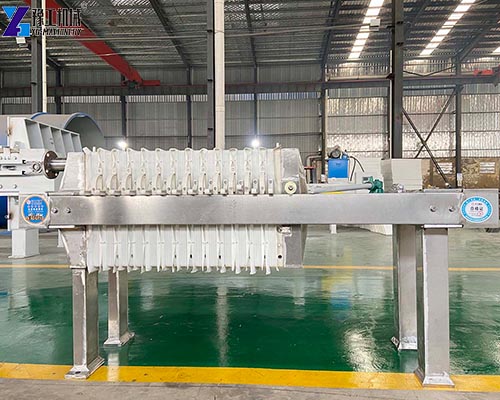
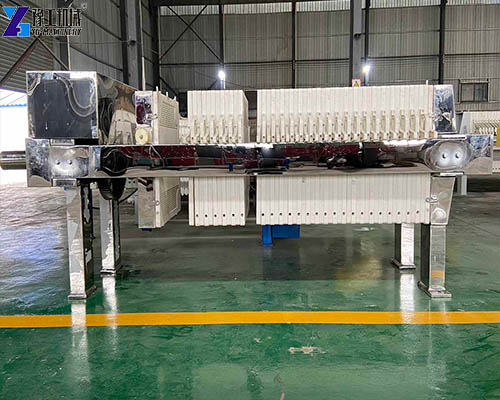
- Filtration section: Several filter plates (or frames) sit in order on the main beams, and a layer of filter cloth separates each pair.
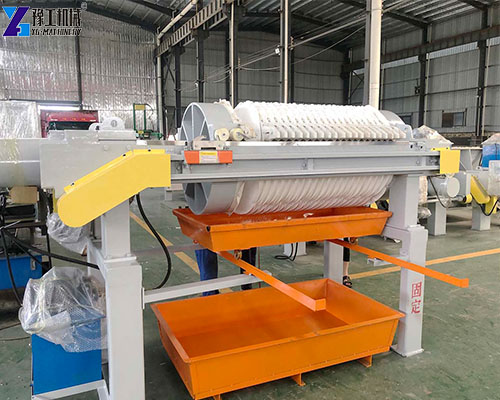
- Clamping section: You can choose manual jack clamping or hydraulic clamping. A manual jack uses a small gear and a lever, and one person can operate it, so small test machines and workshop-style plants often use it. A hydraulic system uses a motor to drive an oil pump, and the oil moves through a control valve into the cylinder. Hydraulic control comes in two modes: automatic pressure holding and program-controlled plate pulling. When the machine is large, a PLC cabinet commands two side plate-pulling carts to pull the plates apart and discharge the cake.
YG supplies the following types:
- Frame filter press: This design uses hydraulic clamping only and has no automatic plate pulling.
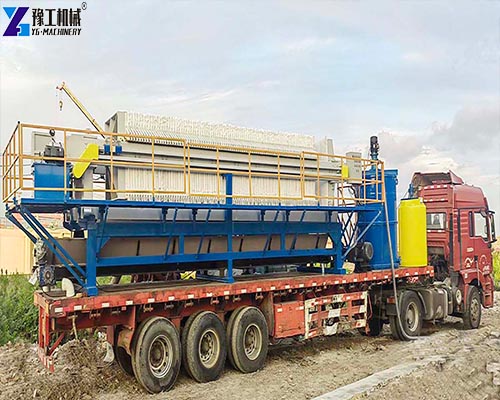
- Chamber filter press: This family covers hydraulic automatic clamping, program-controlled automatic plate pulling, diaphragm squeezing, jack clamping, vehicle-mounted mobile units, and round high-pressure versions.
Get Your Project‑Specific Quote
Technical Parameters of YG Hot-Selling Automatic Models
YG filter presses for sludge dewatering use an electric contact pressure gauge to hold pressure automatically. This setup is easy to operate, runs steadily, and suits machines with a large filtration area. The table below lists our three best-selling models.
| Model | XMZ100/1000-30U | XMZ250/1250-30U | XMZ500/1500-30U |
| Chamber Volume | 1,500 L | 3,750 L | 7,500 L |
| Filtration Area | 100 m² | 250 m² | 500 m² |
| Clamping Pressure | 20 MPa | 20 MPa | 20 MPa |
| Filtration Pressure | 0.6 MPa | 0.6 MPa | 0.6 MPa |
| Overall Weight | 6,628 kg | 14,288 kg | 30,288 kg |
| Number of Movable Plates | 57 pcs | 91 pcs | 123 pcs |
| Number of Chambers | 58 | 92 | 124 |
| Filter Plate Size | 1000×1000×60 mm | 1250×1250×65 mm | 1500×1500×65 mm |
| Quantity of Filter Cloth | 57+1 (cloth for head and tail plates) | 91+1 (cloth for head and tail plates) | 123+1 (cloth for head and tail plates) |
| Overall Dimension | 5780×1500×1400 mm | 8745×1850×1600 mm | 11820×2100×1820 mm |
Besides these three models, we offer many other configurations. The table below shows a few representative examples.
| Type | Model | Filtration Area | Plate Size | Chamber Volume | Filtration Pressure | Motor Power |
| Program-controlled plate pulling | X△Z30/870-30U | 30 m² | 870×870 mm | 460 L | 0.6 MPa | 2.2 kW |
| Program-controlled plate pulling | X△Z80/870-30U | 80 m² | 870×870 mm | 1,210 L | 0.6 MPa | 2.2 kW |
| Diaphragm | XG80/870-300Bk | 80 m² | 870×870 mm | 1,190 L | 0.6 MPa | 2.2 kW |
| Diaphragm | XGZY1500-X250 | 250 m² | 1500×1500 mm | 4,253 L | 0.6 MPa | 7.5 kW |
| Jack clamping | XQ15/450-30U | 15 m² | 450×450 mm | 253 L | 0.6 MPa | No power needed |
| Round high-pressure | X△20/Φ800-30 | 20 m² | Φ800 mm | 247 L | 1.0-2.0 MPa | Not listed |
A model number does not tell the whole story. Therefore, share your slurry details with us, and our team will confirm the best match.
Our standard supporting equipment includes filter plates, an operating platform, a belt conveyor, a dosing and mixing tank, and liquid collecting flip plates. In addition, you can choose anti-corrosion treatment (full-machine plastic spraying, PP cladding, or stainless steel cladding) and fully automatic filter cloth washing.
Receive Detailed Parameter List
Applications of Filter Press For Sludge Dewatering in Sludge and Slurry Treatment
Any job that needs solids separated from liquid under pressure can use this equipment. A filter press for sludge dewatering, for example, turns wet sludge into a cake that you can handle and transport more easily. Furthermore, our range covers several working conditions:
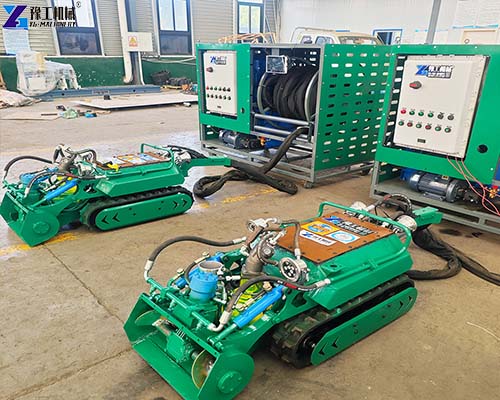
- On-site mud treatment: Our vehicle-mounted, no-ground-contact slurry systems bring the filter press to the job site. The CZ-GMYZ100/1250-30U (100 m², 1,805 L) and CZ-GMYZ220/1250-30U (220 m², 3,800 L) are diaphragm models with a reference system power of 30 to 55 kW. The JDZCXMZ500/1500-30U chamber model offers 500 m² and 7,500 L, fits a 17.5 m flatbed trailer, and weighs 37 tons net.
- Small plants and workshops: Jack-clamped and mechanical models, such as the XQ15/450-30U and the X△J50/800-30U (50 m², 838 L, 3.0 kW), keep the setup simple.
- High-pressure filtration: Round-plate models, such as the X△20/Φ800-30, work at 1.0 to 2.0 MPa.
- Fine filtration support: Our multi-layer stainless steel filters, including the CR-200, CR-400, and F-400, filter down to 0.8 μm as auxiliary equipment.
Not sure whether your material suits a filter press? Send us the details, and we will advise you.
Get Your Project‑Specific Quote
Why Choose YG Sludge Filter Press?
- Automatic pressure holding: The electric contact pressure gauge keeps clamping pressure steady, so operation stays simple and stable. The three hot-selling models clamp at 20 MPa and filter at 0.6 MPa.
- Lower cake moisture: Diaphragm models squeeze the cake after filtration, which improves the separation effect.
- Less manual effort on large machines: A PLC cabinet controls the plate-pulling carts, so large machines unload with less hands-on work.
- Wide model range: You can pick from frame, chamber, diaphragm, jack-clamped, vehicle-mounted, and round high-pressure designs.
- Complete configuration: Platform, belt conveyor, dosing tank, automatic cloth washing, and anti-corrosion options come together as one package.
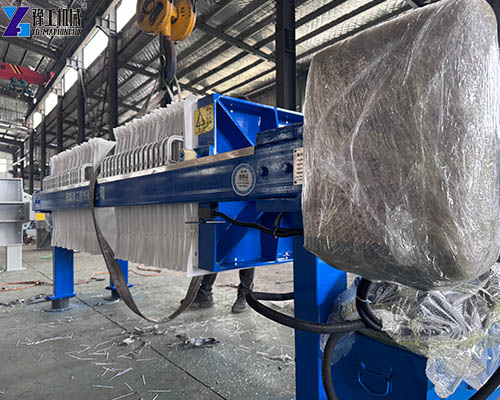
- Secure packing: We weld a steel skeleton, cover it with wooden boards, and ship each machine in one crate. This method protects against damage and lost parts during transport.
YG Dewatering Filter Press Price
Ready to find the right filter press for sludge dewatering for your project? Tell us your slurry type, daily volume, target cake moisture, and power supply. Our team will recommend a model, prepare a quotation, and answer your technical questions. Contact us today and take the first step toward easier, more efficient solid-liquid separation.
Find The Right Solution For Your Job
Filter Press FAQ
A frame filter press uses hydraulic clamping only and has no automatic plate pulling. A chamber model, on the other hand, gives you more choices, including program-controlled plate pulling, diaphragm squeezing, and vehicle-mounted versions.
Choose a diaphragm model. After the filtration step, the system pumps water or air into the diaphragm plates. The plates swell and squeeze the cake, which lowers its moisture content.
Manual jack clamping suits small test machines and workshop-style plants because one person can operate it. Hydraulic clamping is the basic method across our machine types. For large machines, add program-controlled plate pulling.
With open flow, each plate has its own tap, and the filtrate drains directly from every plate. With closed flow, the filtrate from all plates joins and leaves through one pipe.
We use a steel frame with a wooden crate. A welded steel skeleton holds the machine, and wooden boards cover it. This keeps the machine and its parts safe in transit.