You Know the Problem – Standard Excavators Sink in Soft Ground
If you have ever taken a standard excavator into a swamp, marsh, or wetland, you know exactly what happens. The machine sinks. The tracks spin. You get stuck. Your crew spends half a day winching it out. The project falls behind schedule.
Wetlands, marshes, peat bogs, floodplains, and shallow water areas are some of the most difficult environments for construction equipment. Standard excavators exert over 10 PSI of ground pressure, which is far too high for soft, saturated ground. The machine sinks, ruts the terrain, and becomes a liability rather than an asset.
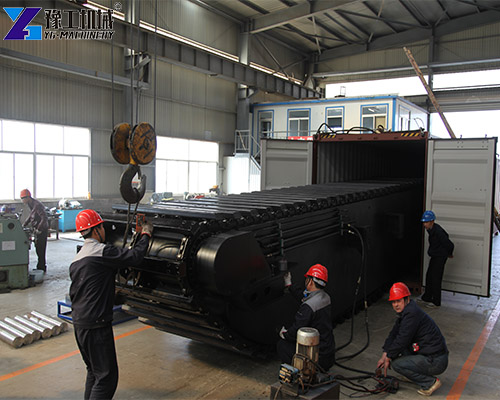
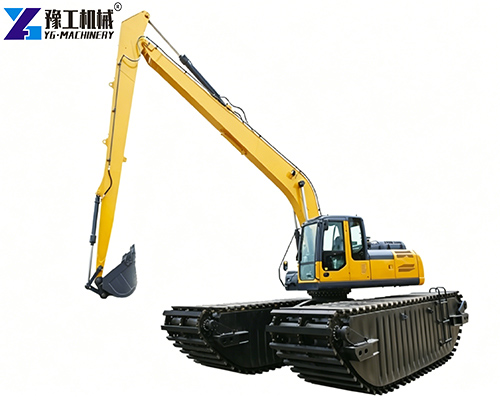
An excavator floating pontoon – also known as an amphibious undercarriage, swamp pontoon, or marsh buggy conversion – is the solution. It replaces the standard track system with sealed, hollow pontoons that provide buoyancy and distribute the machine‘s weight across a much larger surface area. The result: ground pressure drops below 2 PSI. The machine floats on soft ground and shallow water instead of sinking into it.
YG Machinery offers seven excavator pontoon models, covering excavator classes from 6 tons up to 50 tons. Built with two to three chains on each side, these water-capable rigs use Q345 high-tensile steel, extendable undercarriage frames, and stabilizing spud poles to lock firmly into aquatic terrain. Boasting ultra-low ground bearing pressure, the units deliver far superior buoyancy compared to conventional track systems, paired with rust-proof steel floats and detachable side pontoons that simplify haulage between job sites. Contractors handling work inaccessible to ordinary machinery will find them exceptionally dependable, with flexible sizing compatibility spanning compact wetland restoration tasks all the way up to massive dredging and flood mitigation initiatives of every scope.
But with seven sizes and multiple configurations (2-chain vs 3-chain, with or without telescopic range and spud poles), how do you choose the right one? In this head-to-head comparison, we pit YG‘s seven floating pontoon models against each other and against standard track systems, focusing on excavator compatibility, pontoon dimensions, total weight, telescopic range, and project suitability.


Technical Specifications Of YG Excavator Floating Pontoon Models
| Serial No. | Model / Tonnage Class | Number of Chains | Single Bare Body Dimension (m) | Single Assembled Dimension (m) | Overall External Dimension (m) | Total Weight of Pontoons (t) | Material Specification | Side Pontoon Dimension | Production Lead Time (Days) | Telescopic Range | Spud Specification |
| 1 | 6-7 | 2 | 4.5×1×1 | 5.7×1.25×1.34 | 5.7×3.0×1.34 | 6 | Q345 (4×6) | 3×1×0.8m | 20 | / | φ133 (4 m) |
| 2 | 10-16 | 2 | 6×1.25×1.4 | 7.5×1.57×1.74 | 7.5×4.6×1.74 | 13 | Q345 (4×6) | 6×1.5×1m | 20 | 700 mm | φ219 (8 m) |
| 3 | 18-20 Small Model | 2 | 7×1.5×1.5 | 8.5×1.8×1.84 | 8.5×4.6×1.84 | 15 | Q345 (4×6) | 6×1.25×1m | 25 | 700 mm | φ219 (8 m) |
| 4 | 18-22 Large Model | 3 | 8×1.5×1.5 | 9.5×1.8×1.84 | 9.5×5.2×1.84 | 17 | Q345 (4×6) | 6×1.25×1m | 25 | 700 mm | φ219 (8 m) |
| 5 | 27-30 | 3 | 9×1.5×1.5 | 10.5×1.8×1.84 | 10.5×5.4×1.84 | 23 | Q345 (6×8) | 7×1.5×1m | 25 | 600 mm | φ219 (8 m) |
| 6 | 30-40 | 3 | 9×2×1.5 | 10.5×2.4×1.84 | 10.5×6.4×1.84 | 29 | Q345 (6×8) | 8×1.25×1m | 25 | 700 mm | φ273 (9 m) |
| 7 | 40-50 | 3 | 10×2×1.8 | 11.5×2.4×2.14 | 11.5×6.5×2.14 | 31 | Q345 (6×8) | 8×1.5×1m | 30 | 1000 mm | φ273 (9 m) |
All models use Q345 high-strength steel. The pontoons are sealed and hollow, providing buoyancy to keep the excavator afloat in shallow water. Side pontoons are removable for transport. The telescopic frame allows the undercarriage width to be adjusted – narrower for transport, wider for stability during work.
Multi-Dimensional Comparison: YG Floating Pontoons vs Standard Track Systems
Lots of construction contractors try to use regular track excavators on muddy, wet job sites, thinking the machine can tough it out. This rarely works well. We’ll break down 4 key points to show the differences between YG amphibious pontoon undercarriages and standard excavator tracks.
1. Ground Pressure & Anti-Sinking Performance
A regular 20-ton excavator with standard tracks creates 10–12 PSI ground pressure. This works fine on hard, solid ground. But on marshland or soft peat soil, the tracks sink right away. The machine tears up the ground, ruins the job site surface, and loses grip to move.
YG’s wide hollow floating pontoons spread the machine’s weight over a much bigger area. They cut ground pressure down to under 2 PSI. The machine stays on top of soft mud instead of sinking deep. It can work on wet terrain that regular excavators cannot access at all.
2. Stability & Operation in Shallow Water
Standard tracks have zero buoyancy. Once the water goes higher than the track height, the excavator will sink and get stuck.
YG pontoons are fully sealed hollow floats that create strong buoyancy. Depending on the model, the machine can safely work in shallow water up to 1.5 meters deep or more. The widest model reaches an overall width of 6.5 meters, which keeps the machine balanced during dredging and underwater digging. Most models support extra spud poles, which lock the machine firmly in place when working in flowing water or deeper areas.
3. Traction & Movement on Muddy Ground
Standard tracks spin uselessly in thick mud. They lose traction completely and leave the whole machine trapped.
Each side of YG pontoons comes with 2 or 3 heavy-duty drive chains for reliable grip on slippery mud. Since the pontoons stop the machine from sinking, the chains can bite into the ground properly. You can drive freely across marshes, swamps, and flood plains where regular excavators would get buried instantly.
4. Transport & On-Site Assembly
Regular track excavators have a fixed width. You just drive them onto a trailer and ship them directly.
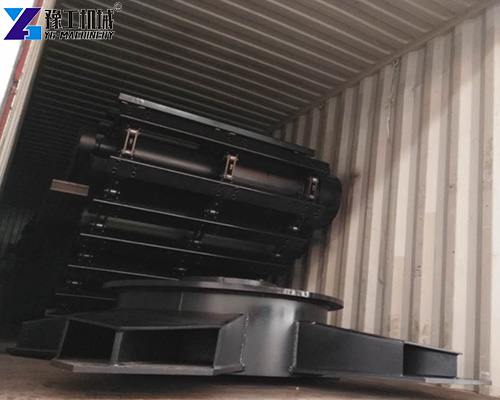
YG pontoons stretch up to 6.5 meters wide when fully opened, so they need simple adjustments before road transport. Luckily, the undercarriage features a telescopic frame to narrow the whole machine. The side pontoons can also be detached separately to cut down transport width further.
After arriving at the job site, expand the undercarriage frame and bolt the side pontoons back on. Full assembly only takes a few hours. The extra setup time is totally worth it, as you can take on wetland and water projects that no standard excavator can handle.


Core Advantages Of YG‘s Excavator Floating Pontoons
Why do contractors working in wetlands, swamps, and flood control projects switch to YG pontoons? Four strong reasons.
Access to Previously Impossible Jobs:
With a standard excavator, you simply cannot bid on marsh reclamation, swamp dredging, or wetland restoration projects. With YG pontoons, these jobs become your specialty. You can work in peat bogs, floodplains, shallow water, and coastal marshes. You can dig drainage channels in lowland areas, clear vegetation from wetlands, and prepare sites for construction in areas that were previously inaccessible. This opens up an entirely new market for your business.
Minimal Site Damage and Environmental Compliance:
Standard excavators rut the ground, damage root systems, and leave deep tracks that take years to heal. In environmentally sensitive areas – wetlands, coastal zones, protected marshes – this is unacceptable. YG pontoons distribute weight so evenly that the ground surface is barely disturbed. You complete the job without destroying the site. This matters for government contracts and environmental restoration projects where site preservation is a requirement.
Versatility Across Multiple Applications:
YG pontoons are not just for swamps. They are used for plain marshland management, low-yield farmland transformation, water diversion projects, saline-alkali land improvement, urban water supply projects, coastal tideland management, reclamation projects, offshore oil and gas wellsite work, tailings pond management, photovoltaic projects, land reclamation, dredging and excavation, slope repair, embankment construction, drainage pipeline installation, and flood control emergency response. One undercarriage conversion gives your excavator access to all of these applications.
Durable Q345 Steel Construction with Corrosion Resistance:
The pontoons are fabricated from Q345 high-strength steel – a material known for its excellent strength-to-weight ratio and resistance to impact. The pontoons are sealed and welded to prevent water ingress. The 4×6 or 6×8 material specifications (depending on model) provide the structural strength needed to support the full weight of the excavator during digging, swinging, and lifting operations. With proper maintenance – regular inspection of welds and seals – a YG pontoon undercarriage lasts for years in demanding wetland conditions.
Upgrade Your Excavator For Wetland Work Today – Get The Right Floating Pontoon For Your Machine
Stop getting stuck in swamps and losing bids on wetland projects. YG Machinery – Shaping Tomorrow Since 2005 – has supplied excavator floating pontoons to contractors working in marshes, swamps, floodplains, and coastal areas worldwide. Our Q345 steel pontoons, telescopic frames, and spud pole systems are proven in the toughest conditions.
Contact us now for a free consultation. Tell us your excavator make, model, and tonnage, and describe the typical ground conditions you work in. We will recommend the right YG pontoon model – and we will not push you toward a bigger system than you need.