You have a pile of broken concrete. Or a mountain of demolition rubble. Or a bunch of rocks that need to become gravel.
Every time you load those chunks into a truck and send them to a crusher, you’re paying for transport, tipping fees, and someone else’s profit.
What if you could crush it right there – on site, with your own excavator?
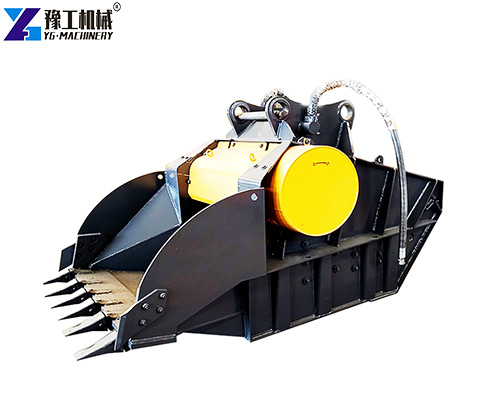
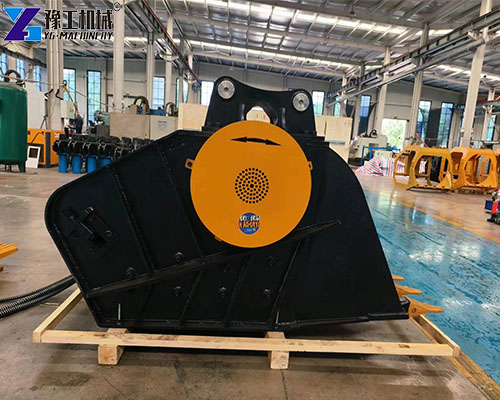
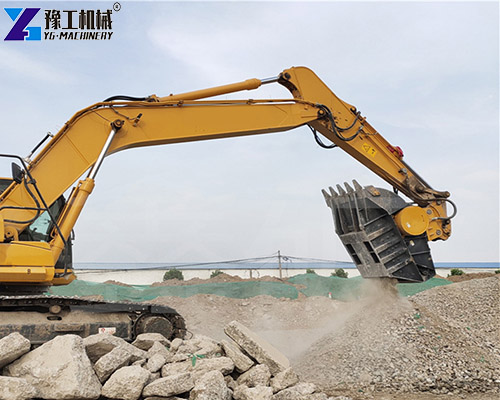
That’s exactly what a rock crusher bucket does. It turns your digging machine into a mobile crushing plant. No trucks. No middleman. Just crushed material, ready to reuse.
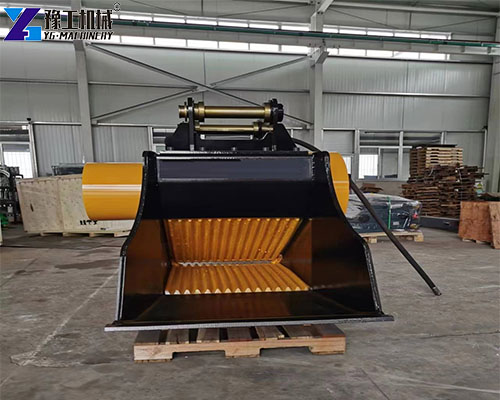
What Is A Concrete Crusher Bucket Anyway?
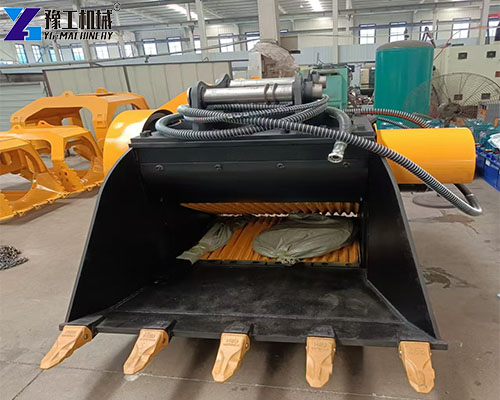
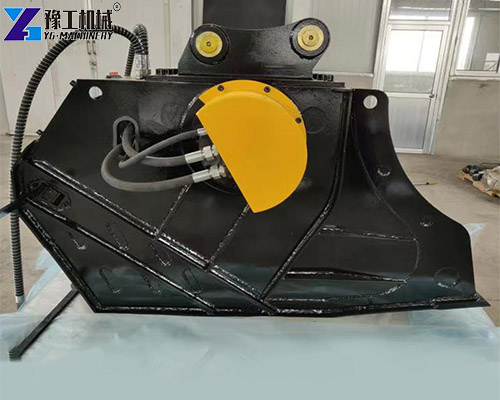
It’s a bucket that crushes. Simple.
Instead of just scooping and dumping, this bucket has two powerful jaws inside. One jaw is fixed, the other moves back and forth – like a giant set of teeth chewing rocks.
You feed it demolition concrete, asphalt, or natural stone. It chews it down to a size you choose, from as small as 15 mm up to 200 mm.
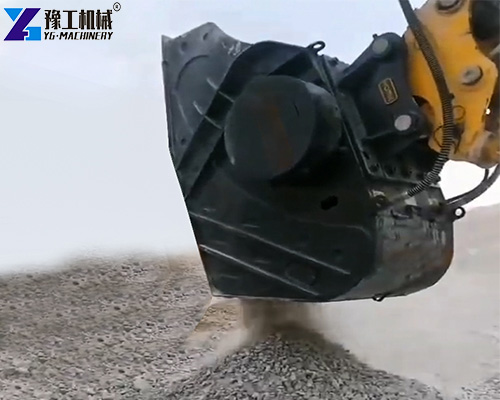
The crushed material comes out the bottom, ready to use as base material, backfill, or aggregate.
All powered by your excavator’s hydraulics. No extra engine. No external power source.
Who Actually Buys A Rock Crusher Bucket?
From our real customer list:
Demolition contractors – tearing down buildings, crushing the concrete on site, and using it as backfill for the same foundation. No hauling away. No buying new gravel.
Road construction crews – breaking up old asphalt, crushing it, and reusing it as road base material. Massive cost savings.
Quarry operators – crushing oversize rocks into smaller, saleable aggregate. No need for a fixed crusher plant.
Tunnel and excavation projects – turning excavated rock into usable fill. Reduces disposal costs and material import costs.
Landscaping and hardscaping – crushing stone for pathways, drainage layers, or decorative gravel.
One contractor in Australia told us, “I used to spend $2,000 a day on trucking demolition concrete to a crusher. Now I crush it on site with my concrete crusher bucket. I saved $15,000 on one job alone.”
The Numbers You Actually Care About
| SPECIFICATION | UNIT | YG-1 | YG-2 | YG-3 | YG-4 | YG-5 | YG-6 | YG-7 | YG-8 |
| Carrier Weight | Ton | 8-12 | 14-18 | 120-25 | 25-30 | 30-35 | 35-50 | 50-75 | ≥ 75 |
| Load Capacity | m³ | 0.15 | 0.55 | 0.66 | 0.70 | 0.90 | 1.30 | 1.60 | 2.30 |
| Opening Dimensions | mm | L540 H250 | L610 H510 | L740 H510 | L850 H510 | L910 H540 | L1205 H540 | L1300 H600 | L1450 H700 |
| Output Setting | mm | 15-60 | 15-60 | 15-130 | 15-135 | 15-140 | 15 – 145 | 40-150 | 100-200 |
| Length (A) | mm | 1240 | 1745 | 2000 | 2050 | 2185 | 2185 | 2930 | 3560 |
| Width (B) | mm | 1000 | 1000 | 1150 | 1300 | 1340 | 1620 | 1880 | 2090 |
| Height (C) | mm | 770 | 1100 | 1200 | 1400 | 1390 | 1390 | 170 | 2065 |
| Weight | Ton | 0.75 | 1.6 | 2.3 | 3 | 3.5a | 4.8 | 7.5 | 10.5 |
| Oil Flow | l/min | 90 | 98 | 140 | 160 | 180 | 210 | 320 | 380 |
| Pressure | bar | 200 | 220 | 220 | 220 | 220 | 220 | 250 | 230 |
| Counter | bar | 10 | 10 | 10 | 10 | 10 | 10 | 10 | 10 |
| Max. Production | m³/h | 10 | 23 | 31 | 34 | 42 | 53 | 88 | 120 |
How To Choose The Right Rock Crusher Bucket?
- Excavator weight – start here. Match your machine to the “Carrier Weight” column. If you have a 20‑ton excavator, choose YG-3. If you have a 35‑ton machine, choose YG-6.
- Material type – soft rock (limestone) can use a smaller model. Hard rock (granite) needs a larger model with more crushing force.
- Output size – do you want fine gravel (15–40 mm) or coarse fill (100–200 mm)? The smaller the output size, the slower the production. Find the balance.
- Production rate – how many cubic metres do you need per hour? Bigger bucket = faster production.
- Hydraulic flow – check your excavator’s auxiliary flow. Must be within the model’s required range. If you’re not sure, send us your machine model, and we’ll confirm.
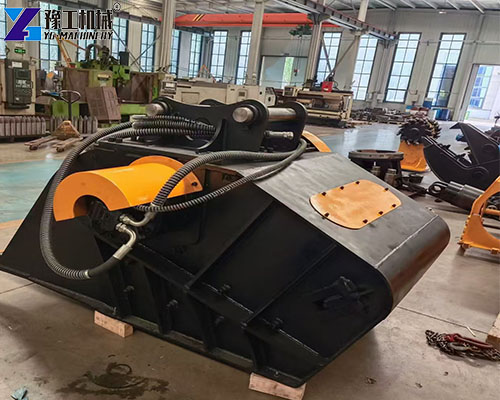
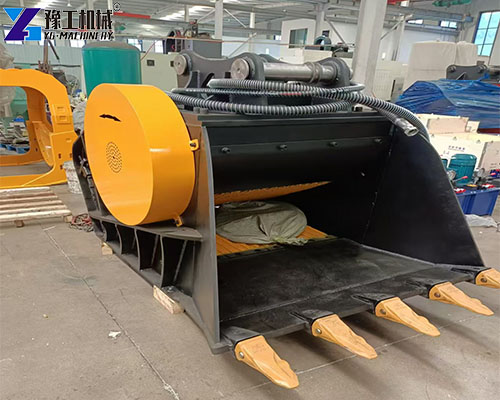
How To Install A Concrete Crusher Bucket?
- Remove your standard bucket. Keep the pins.
- Attach the crusher bucket to your excavator arm using the same pin holes.
- Connect the two hydraulic hoses to your auxiliary circuit (pressure and return).
- If your excavator has a third line for bucket rotation, connect that too (optional).
- Test the jaw movement. Open and close it a few times without material.
- Adjust the jaw gap to your desired output size using the adjustment mechanism.
We include a manual and a video. First installation takes about 30 minutes. After that, swapping from bucket to crusher takes 10 minutes.
Operating Tips For Maximum Efficiency
- Feed gradually – don’t dump a whole pile at once. Let the jaws chew before adding more.
- Use the bucket’s curl function – curling the bucket helps shake material down into the crushing zone.
- Crush in short cycles – 30–60 seconds of crushing, then dump the crushed material. Repeat.
- Keep the jaw plates sharp – worn plates reduce crushing efficiency. Replace them when worn (we supply spares).
- Grease pivot points every shift – dry pins wear out fast.
What About Maintenance?
Daily:
- Grease all pivot points
- Check hoses for leaks or chafing
- Inspect jaw plates for wear
Weekly:
- Check bolt tightness (vibration loosens them)
- Clean the bucket interior of dust and debris
Monthly:
- Check hydraulic oil condition (change if dirty)
- Inspect the adjustment mechanism
Every 500 hours:
- Replace jaw plates if worn
- Change hydraulic oil in the bucket’s internal circuit (if applicable)
Try A Concrete Crusher Bucket For 30 Days – No Risk
You’re thinking: “What if my excavator’s flow isn’t enough? What if it can’t crush my material?”
We’ll ship you the bucket based on your machine specs. You mount it. You crush your toughest material for 30 days.
If it doesn’t work – too slow, too weak, too heavy, or if you simply don’t like it – return it. Full refund. We pay return shipping.
This offer is for the first 6 units worldwide.
One Last Truth
Sending concrete and rock to the landfill costs money. Buying gravel costs money.
A concrete crusher bucket turns waste into valuable material – right where you stand.
No trucks. No tipping fees. No waiting.
Stop paying to get rid of rubble. Start crushing it into cash.
👉 Email admin@chinayugongmachinery.com now. Tell me:
- Your excavator brand, model, and weight
- What material do you need to crush (concrete, rock, asphalt)
- What output size do you need (fine, medium, coarse)
I’ll reply within 24 hours with:
- The exact model for your machine
- A video of that bucket in action
- A delivered price to your port
Scoop. Crush. Reuse. Repeat.