You know the feeling.
You’re working in a marsh, a swamp, or along a riverbank. The ground looks solid enough. You move your excavator forward a few meters. Then you feel it — a slow, sickening tilt. The tracks are sinking. Mud is creeping up the side of the undercarriage. Within minutes, your machine is stuck. Not just stuck — stuck.
Now you need a second excavator to pull out the first. That means lost time, lost money, and a very unhappy client.
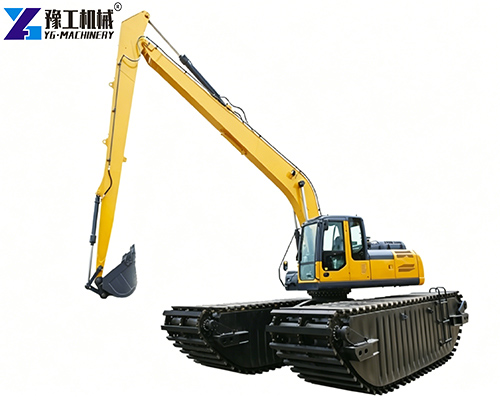
A flotation undercarriage for excavator changes that story entirely.

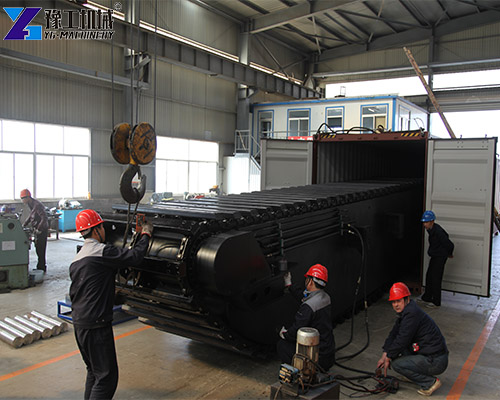
Why Standard Excavators Sink — And What An Amphibious Undercarriage Does Differently?
A standard excavator is built for solid ground. Steel tracks, heavy frame, high ground pressure. Put it on soft soil, and it sinks. Simple physics.
An amphibious undercarriage solves this problem with one big change: pontoons.
Instead of narrow steel tracks, your excavator sits on wide, sealed pontoons — think of them like the hulls of a boat. They spread the machine’s weight over a much larger area. Ground pressure drops dramatically. Your excavator floats over mud, marsh, and shallow water instead of sinking into it.
The result? You can work where no standard excavator can go.
Where Does An Amphibious Undercarriage Actually Work?
Swamp and wetland restoration. Drainage channels, dike construction, and low-yield farmland improvement. Standard excavators can’t even reach the site. A flotation undercarriage for excavator drives right in.
Coastal and tidal flat work. Reclamation projects, seawall construction, shallow-water oil and gas well sites. Your excavator works where the tide goes in and out — no problem.
Dredging and silt removal. Canals, rivers, tailings ponds. You dig, you dredge, you haul — all from a machine that doesn’t sink.
Pipeline and cable installation. Laying pipes across marshes or floodplains. The excavator carries the pipe, digs the trench, and backfills — all in one pass.
Flood control and emergency response. When the water rises, you need equipment that works in wet conditions. A flotation undercarriage for excavator keeps working when others are stuck on dry land.
Solar farm and photovoltaic construction. Large-scale solar projects often sit on soft, reclaimed land. Standard excavators rut the ground. Amphibious pontoons spread the weight and protect the surface.
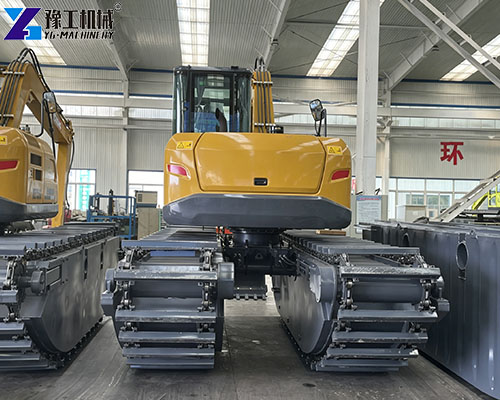

How To Choose The Right Flotation Undercarriage For Excavator?
Not all excavators are the same. Not all jobs are the same. The table below (straight from our product document) shows exactly which undercarriage fits which machine.
| Serial No. | Model / Tonnage Class | Number of Chains | Single Bare Body Dimension (m) | Single Assembled Dimension (m) | Overall External Dimension (m) | Total Weight of Pontoons (t) | Material Specification | Side Pontoon Dimension | Production Lead Time (Days) | Telescopic Range | Spud Specification |
| 1 | 6-7 | 2 | 4.5×1×1 | 5.7×1.25×1.34 | 5.7×3.0×1.34 | 6 | Q345 (4×6) | 3×1×0.8m | 20 | / | φ133 (4 m) |
| 2 | 10-16 | 2 | 6×1.25×1.4 | 7.5×1.57×1.74 | 7.5×4.6×1.74 | 13 | Q345 (4×6) | 6×1.5×1m | 20 | 700 mm | φ219 (8 m) |
| 3 | 18-20 Small Model | 2 | 7×1.5×1.5 | 8.5×1.8×1.84 | 8.5×4.6×1.84 | 15 | Q345 (4×6) | 6×1.25×1m | 25 | 700 mm | φ219 (8 m) |
| 4 | 18-22 Large Model | 3 | 8×1.5×1.5 | 9.5×1.8×1.84 | 9.5×5.2×1.84 | 17 | Q345 (4×6) | 6×1.25×1m | 25 | 700 mm | φ219 (8 m) |
| 5 | 27-30 | 3 | 9×1.5×1.5 | 10.5×1.8×1.84 | 10.5×5.4×1.84 | 23 | Q345 (6×8) | 7×1.5×1m | 25 | 600 mm | φ219 (8 m) |
| 6 | 30-40 | 3 | 9×2×1.5 | 10.5×2.4×1.84 | 10.5×6.4×1.84 | 29 | Q345 (6×8) | 8×1.25×1m | 25 | 700 mm | φ273 (9 m) |
| 7 | 40-50 | 3 | 10×2×1.8 | 11.5×2.4×2.14 | 11.5×6.5×2.14 | 31 | Q345 (6×8) | 8×1.5×1m | 30 | 1000 mm | φ273 (9 m) |
What Customers Actually Do With An Amphibious Undercarriage?
Let me give you real examples from the field:
A pipeline contractor in Southeast Asia needed to lay a gas line across 3 kilometers of mangrove swamp. Standard excavators couldn’t even get to the site. They installed an amphibious undercarriage for excavator on their 20-ton machine. The excavator drove through the swamp, dug the trench, laid the pipe, and backfilled — all without sinking. The project finished two weeks ahead of schedule.
A coastal reclamation project in Africa used three 30-ton excavators with flotation undercarriages to build seawalls on tidal flats. The tides came in twice a day. Standard machines would have been flooded and ruined. The amphibious undercarriages worked through high tide and low tide, 12 hours a day, for six months.
A mining company in South America needed to clean out a tailings pond. The sludge was too soft for standard equipment. They fitted their 40-ton excavator with a flotation undercarriage for excavator. The machine floated on the tailings, dredged the sludge, and pumped it to a dewatering plant. No other equipment could do the job.
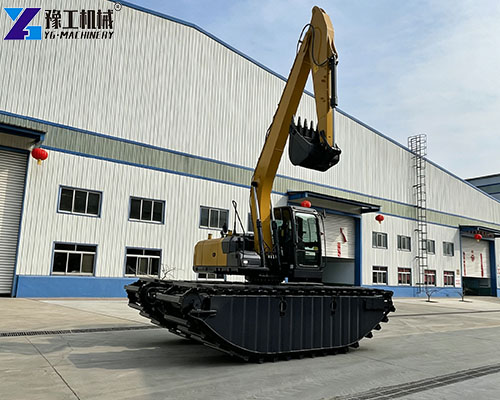

What About Maintenance And Durability?
The pontoons are made from Q345 steel — the same material used in bridge construction and shipbuilding. Welded, sealed, and tested for watertight integrity.
The undercarriage includes a reinforced track frame that bolts directly to your existing excavator. We provide all mounting hardware and installation instructions.
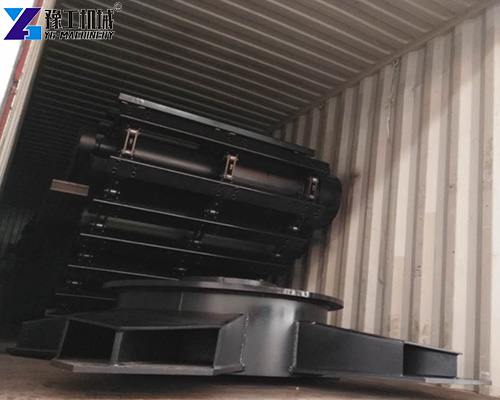
Lead time: 20-30 days, depending on the model. We ship worldwide.
Your Next Step
Look at your excavator. What size is it? What kind of ground do you work on?
If you’ve ever said, “I wish I could work in that swamp” or “I lost a machine in that mud,” an amphibious undercarriage is your answer.
Send us your excavator model and weight. We’ll recommend the right flotation undercarriage for excavator from the table above.
Then start working where others can’t. Start winning bids that others can’t touch. Start making money that others leave on the table.
Phone / WhatsApp / WeChat:+86 159 3715 3321