
You have a rock face to cut, a concrete wall to slice, or a trench to carve through solid stone. A breaker smashes and cracks – leaving rough, uneven edges. What if you could cut rock as cleanly as a saw cuts wood, using the excavator you already own?
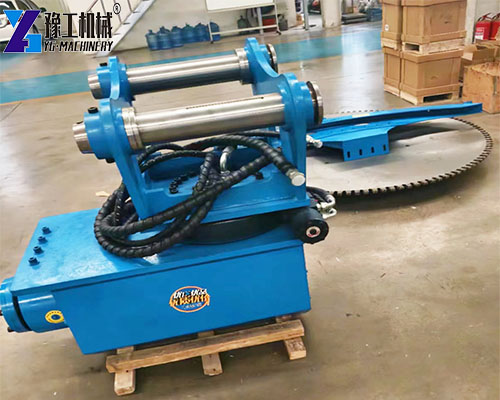
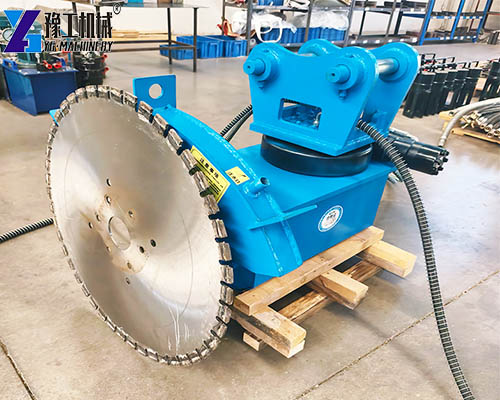
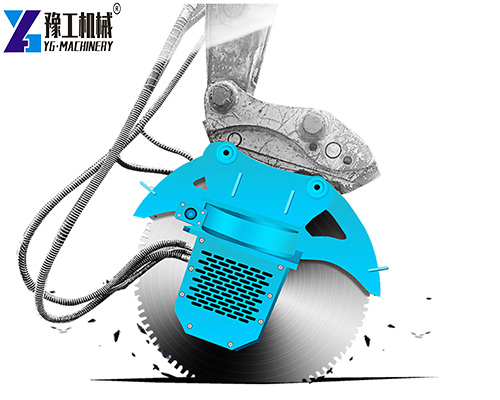
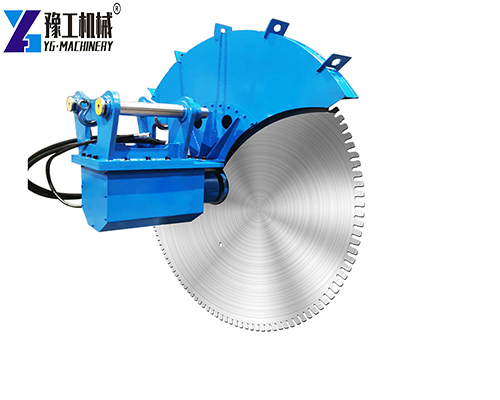
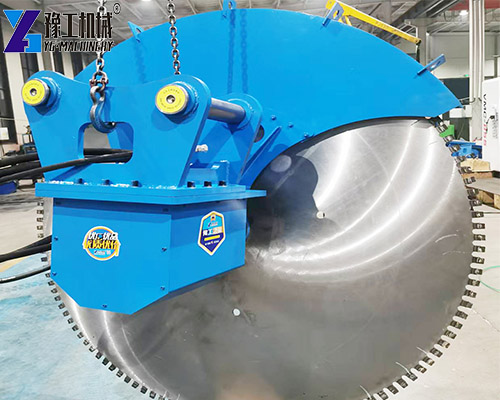
That is exactly what a hydraulic rock saw does. It is a large circular saw blade driven by a hydraulic motor, mounted on your excavator’s arm. It spins at high speed and cuts through granite, basalt, reinforced concrete, and asphalt. The cut is clean, straight, and precise. No vibration. No flying debris. You get a finished edge that needs no rework.
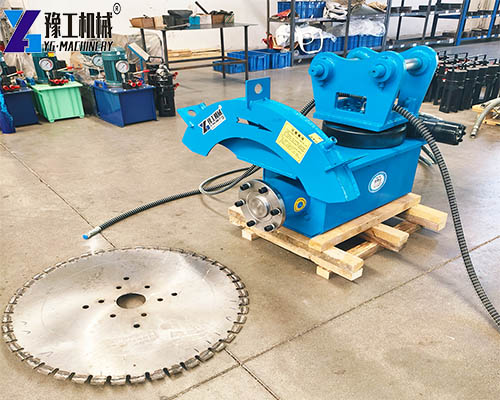
YG Machinery offers four models of rock cutting saw machines: YGJ04, YGJ06, YGJ08, and YGJ10. They fit excavators from 6 tons up to 40 tons. Blade sizes range from 800mm to 1800mm. Machine weight from 200kg to 700kg. Each model is available in a fixed type or a 360° rotation type.
YG Hydraulic Rock Saw – Key Specifications
Here are the complete parameters for all models. Choose based on your excavator size and cutting needs.
| Model/Motor Model | YGJ04 | YGJ06 | YGJ08 | YGJ10 | ||||
| Rotation Mode | Fixed Type | 360°Rotation | Fixed Type | 360°Rotation | Fixed Type | 360°Rotation | Fixed Type | 360°Rotation |
| Applicable excavators (T) | 6-12 | 6-12 | 12-20 | 12-20 | 20-30 | 20-30 | 30-40 | 30-40 |
| Machine weight (KG) | 200 | 260 | 350 | 450 | 500 | 600 | 500 | 700 |
| Saw blade size (mm) | 800 | 1200 | 1600 | 1800 | ||||
| Theoretical Displacement (ml/r) | 154 | 154 | 493 | 792 | ||||
| Torque (N.m) | 600 | 600 | 1923 | 3100 | ||||
| Peak Pressure (MPa) | 40 | 40 | 40 | 40 | ||||
| Unit Torque (N.m/MPa) | 24 | 24 | 76.9 | 124 | ||||
| Continuous Speed (r/min) | 1-650 | 1-650 | 1-550 | 1-500 | ||||
| Maximum Speed (r/min) | 1100 | 1100 | 800 | 600 | ||||
How Does A Hydraulic Rock Saw Work?
An excavator rock saw attachment is a simple but powerful tool.
Step 1 – Power. Your excavator’s hydraulic system sends pressurised oil to the saw’s hydraulic motor. The motor spins the blade.
Step 2 – Cutting. The operator lowers the spinning blade onto the rock or concrete. The blade’s diamond-tipped teeth grind through the material. The saw cuts a narrow slot – typically 10‑20mm wide. For deep cuts, you make multiple passes, each time going deeper.
Step 3 – Finish. The cut is clean and straight. The edges are smooth – no jagged breaks. No secondary finishing needed.
The blade speed is adjustable (continuous speed range). For soft materials, run faster. For hard granite, slow down to reduce wear. The maximum speed is higher, but you rarely need full speed for cutting.
Where Can You Use An Excavator Rock Saw Attachment?
- Earthworks and rock excavation – Cutting through rock for foundations, basements, or road beds.
- Rock trenching – Creating trenches for pipelines, cables, or drainage in solid rock.
- Roadside cutting – Trimming rock faces along highways or railways.
- Building demolition – Cutting precise openings in concrete walls or floors.
- Quarrying and mining – Cutting blocks of stone for dimension stone production.
- Landscaping – Shaping rock features, cutting stone for retaining walls.
The saw works on granite, basalt, reinforced concrete, and asphalt. It can cut both vertical and horizontal surfaces, depending on the rotation mode.

Fixed Type vs 360° Rotation – What’s the Difference?
This is one of the key choices buyers make. Both are available for every model.
| Feature | Fixed Type | 360° Rotation Type |
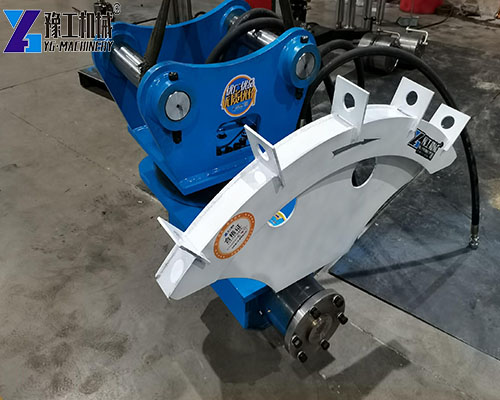
| Blade movement | Blade stays in one plane | The blade rotates 360° continuously |
| Weight | Lighter (e.g., 200kg vs 260kg for YGJ04) | Heavier (adds rotation motor) |
| Versatility | Good for straight cuts in one direction | Can cut at any angle – horizontal, vertical, sloped |
| Best for | Road cutting, trenching in a straight line | Complex cuts, building openings, and undercutting |
| Cost | Lower | Higher |
Choose fixed type if most of your work is straight-line cutting (trenches, roadside trimming). Choose 360° rotation if you need to cut at multiple angles – building demolition, complex rock shaping, or working around obstacles.
Key Features of YG Hydraulic Rock Saws
- High cutting capacity – Blades up to 1800mm diameter. One pass cuts deep into rock or concrete.
- Adjustable speed – Continuous speed range (1‑650 rpm) lets you match the speed to the material. Harder materials = slower speed.
- High torque – Up to 3100 N.m on the YGJ10 – enough to cut through granite.
- Two rotation options – Fixed or 360° rotation. Choose what fits your work.
- Heavy-duty construction – Built for continuous use in tough conditions.
- Diamond blade compatible – Uses standard diamond segmented blades for cutting rock and concrete.
- Easy mounting – Pins to your excavator arm using standard pin sizes.
Cut Rock Cleanly With YG Hydraulic Rock Saw
A hydraulic rock saw is the right tool for precise cutting of rock and concrete. YG offers four models for 6‑40 ton excavators. Blade sizes from 800mm to 1800mm. Torque from 600 N.m to 3100 N.m. Each model comes in a fixed or a 360° rotation type. The saw cuts clean, straight lines through granite, basalt, concrete, and asphalt – with minimal vibration and noise. For trenching, roadside cutting, demolition, quarrying, or landscaping, an excavator rock saw attachment saves time and reduces rework.
Contact YG with your excavator make, model, and typical cutting depth. They will recommend the right rock-cutting saw model and provide a quote. Start cutting – not breaking.
Frequently Asked Questions
20‑30 tons. A 25‑ton excavator is perfect. Do not use it on a 15‑ton machine – it will be too heavy and lack the hydraulic flow.
Yes. Asphalt is softer than concrete, so cutting is faster. The saw also works for road repair and milling.
It makes a grinding noise, but much less than a breaker. No impact noise. Better for urban or residential sites.
The blade is bolted to the motor shaft. Remove the guard, unbolt the old blade, install the new one, and retighten. Standard procedure.