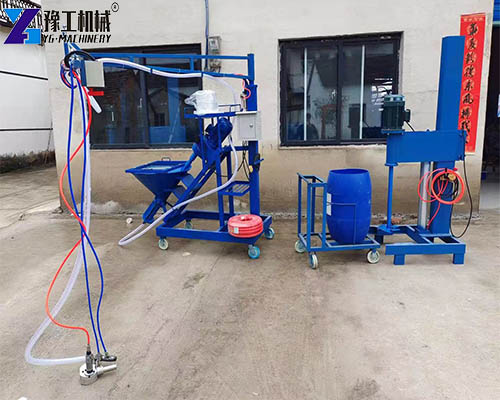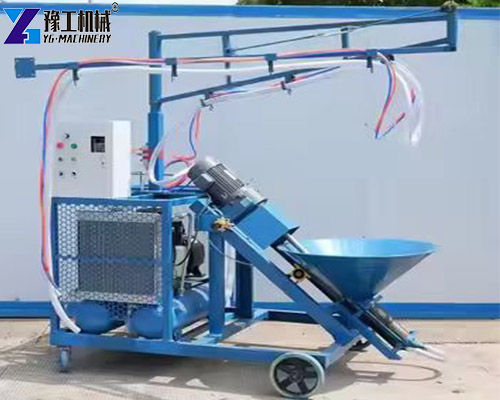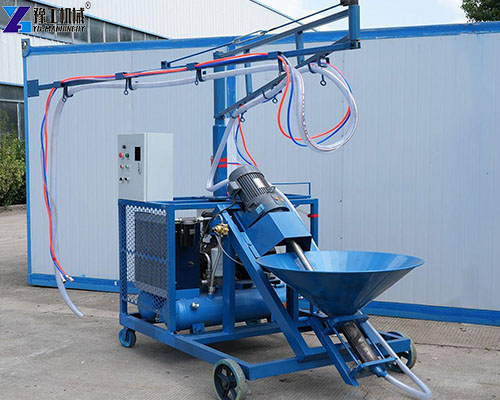
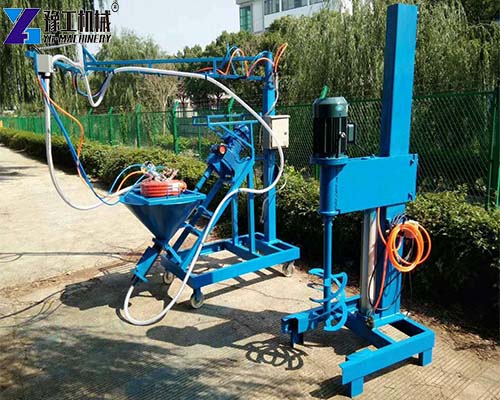
GRC spray equipment is designed for spraying glass fiber-reinforced concrete mixtures onto molds or surfaces. It combines material conveying, alkali-resistant glass fiber cutting, mixing, and spraying in one production process.
The equipment is suitable for GRC decorative panels, architectural lines, columns, sculptures, landscaping products, and other shaped components. It addresses low manual production efficiency, uneven fiber distribution, unstable component quality, rising labor costs, and material waste.
How Does GRC Equipment Work?
The spraying process combines cement mortar with short-cut glass fiber before the mixture is sprayed onto the mold surface.
The basic working process is:
Cement Mortar Feeding → Glass Fiber Cutting → Fiber and Mortar Mixing → High-Pressure Spraying → Layered Spraying and Compaction
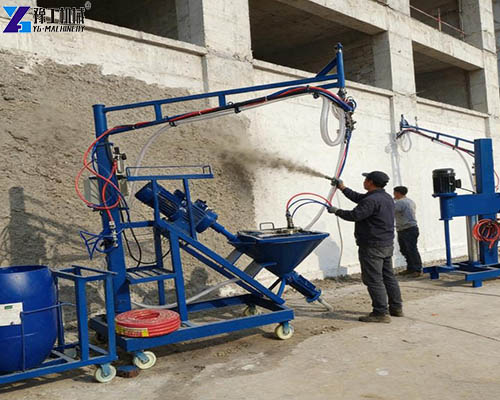
The mortar is continuously delivered to the spray gun. At the same time, alkali-resistant glass fiber is automatically cut. The mortar and fiber are then mixed inside the spray gun and evenly sprayed onto the mold.
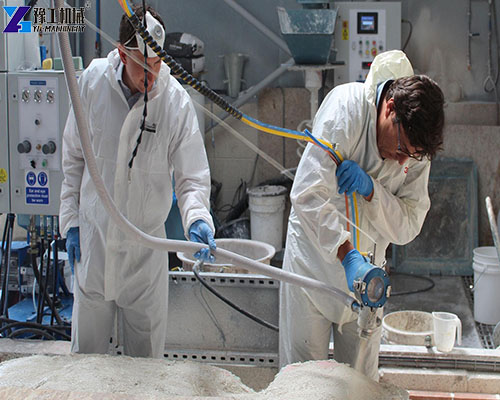
The material can be sprayed in layers and compacted during forming. This synchronized process helps achieve more consistent fiber distribution and GRC component quality.
Get Your Project‑Specific Quote
What Makes YG GRC Spray System Different?
The main difference is its ability to handle glass fiber during the spraying process.
Traditional manual production requires workers to place or distribute glass fiber separately. This can reduce production efficiency and create consistency problems.
The grc spray process supports automatic fiber cutting and synchronized spraying. Its screw design is also intended to prevent material clumping when handling fiber-containing mixtures.
Compared with a conventional mortar sprayer, the equipment is designed specifically for cement, sand, and glass fiber mixtures. A standard mortar sprayer cannot handle short fibers in the same way.
What Are the Core Features of GRC Spray Equipment?
The equipment focuses on five main production requirements:
| Core Feature | Production Value |
| Glass fiber cutting and spraying | Supports fiber distribution during spraying |
| Uniform spraying | Helps improve component consistency |
| High-efficiency production | Shortens production cycles |
| Material-saving system | Helps reduce material waste |
| Simple operation | Reduces operator training requirements |
The system can support continuous production and adjustable spraying output. The supplied product information also states that automated mixing and faster spraying can reduce labor requirements.
Receive Detailed Parameter List
What Are the Technical Specifications of the GRC Spray?
The available machine uses a 380V three-phase power supply and a 2.2-4.0 kW stepless speed regulation motor. Its delivery capacity is 300-1600 kg/h, while productivity is 200-400 m²/h.
| Parameter | Specification |
| Machine Name | Screw GRC Shotcrete Machine |
| Voltage | 380V, 3 Phase |
| Frequency | 50Hz |
| Motor Power | 2.2-4.0 kW |
| Speed | 20-200 r/min |
| Working Area | 4.5m horizontal boom radius |
| Delivery Capacity | 300-1600 kg/h |
| Capacity | 60L |
| Working Pressure | 0.6-0.8 MPa |
| Productivity | 200-400 m²/h |
| Machine Size | 1400 × 1000 × 2200mm |
| Machine Weight | 220kg |
The motor speed can be adjusted while the machine is running. The working pressure and delivery capacity provide the main technical references for matching the equipment with the production process.
Find The Right Solution For Your Job
Where Can GRC Equipment Be Used?
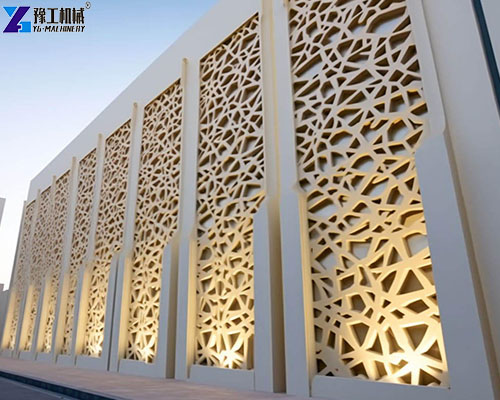
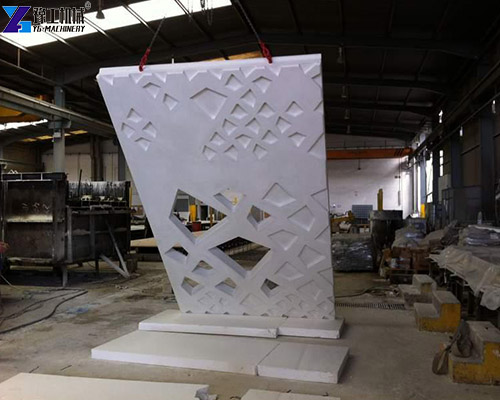
GRC spray equipment is suitable for manufacturers and contractors producing different types of GRC components.
Typical applications include:
- Exterior decorative panels
- Architectural lines
- Columns
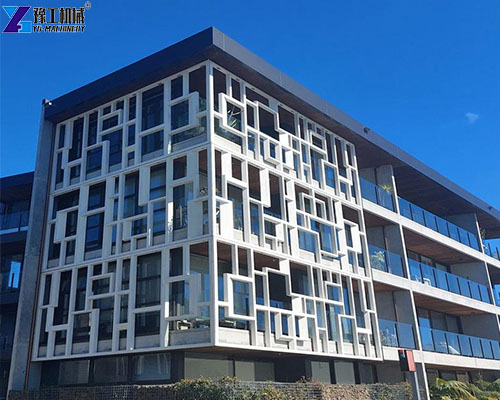
- Curtain wall panels
- Decorative boards
- Sculptures
- Flower pots
- Artificial rock and landscaping components
- Reliefs
- Complex-shaped GRC products
For architectural decoration manufacturers, the machine can support batch production of exterior panels and decorative lines.
For precast factories, it can be used for curtain wall and decorative panel production.
For landscaping companies, the spraying method can adapt to complex molds and shaped components.
Get Your Project‑Specific Quote
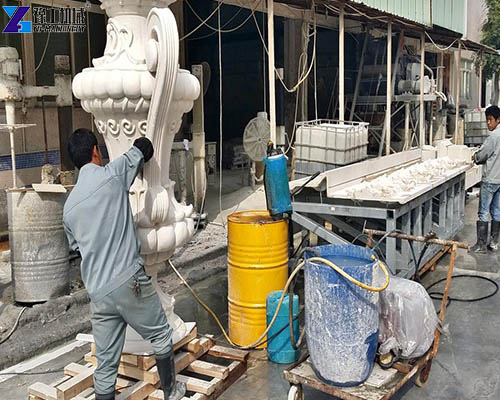
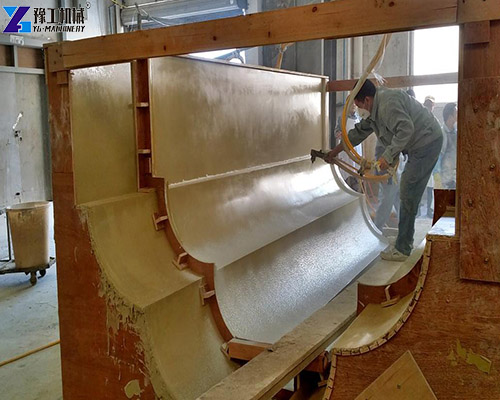
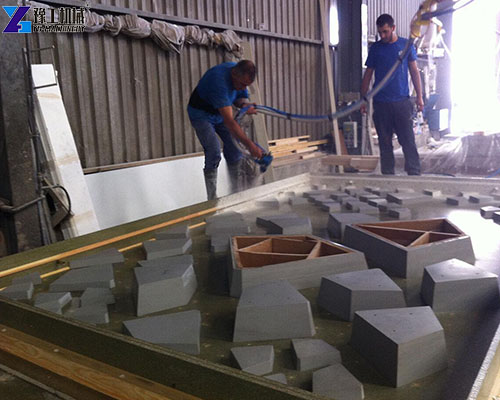
Can GRC Spray Handle Complex Shapes?
Yes. The supplied product information specifically identifies complex and irregular components as an application area.
The spray gun can apply the GRC mixture to different mold shapes. This makes the equipment suitable for sculptures, artificial rock, reliefs, decorative components, and other products that are difficult to manufacture efficiently through simple manual production.
For manufacturers handling multiple product shapes, the spraying method provides a more flexible production approach than fixed-form manual processing.
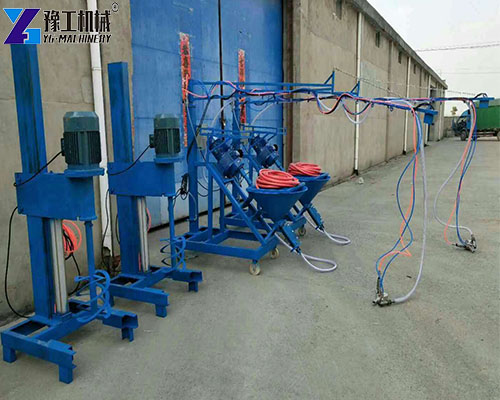
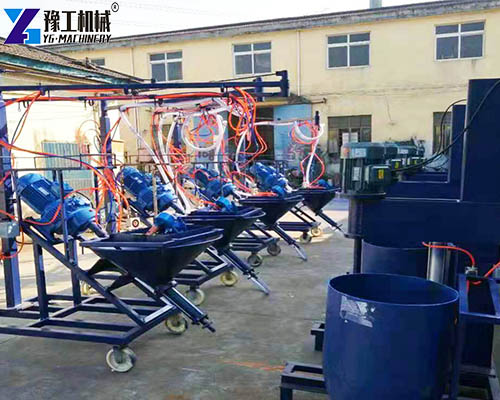
What Supporting GRC Spray Equipment Is Required?
The machine can be used together with several supporting systems.
The supplied information identifies:
- Air compressor
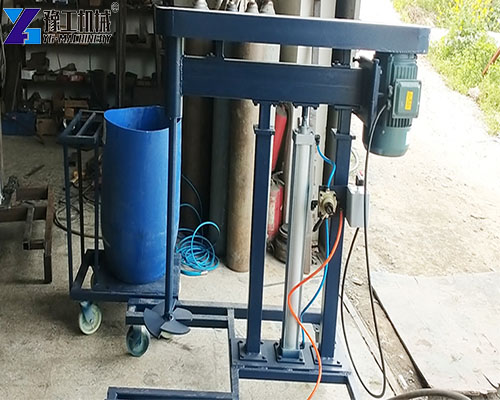
- Mixer
- Material feeding system
as the main supporting equipment.
For the listed 4 kW and 2.2 kW machine configurations, the product information recommends an 11 kW screw air compressor.
The mixer configuration can also vary according to motor power:
| Solution | GRC Spray Machine | Mixer |
| Solution 1 | 2.2 kW | 1.5 kW |
| Solution 2 | 3.0 kW | 1.5 kW |
| Solution 3 | 3.0 kW | 2.2 kW |
| Solution 4 | 4.0 kW | 2.2 kW |
| Solution 5 | 4.0 kW | 5.5 kW |
This configuration should be selected according to the required production setup rather than treating the machine as an independent unit.
Get Your Project‑Specific Quote
How Does GRC Spray Reduce Manual Work?
Manual GRC production can require separate fiber placement, mortar application, forming, and repeated finishing work.
The machine integrates several of these production steps into a continuous spraying process. Glass fiber cutting and mortar spraying can be performed simultaneously.
The supplied information states that automated mixing and faster spraying can save the labor equivalent of approximately 1-2 workers per year of operation. It also reports a 30% improvement in strength compared with the older model. These figures are product-source claims and should be evaluated according to the actual production configuration.
Is GRC Spray Equipment Suitable for Batch Production?
Yes. Batch production is one of the main reasons customers choose the machine.
GRC component manufacturers can use it to improve production efficiency, stabilize fiber distribution, reduce manual work, and support continuous operation.
It is particularly relevant for:
| Customer Type | Main Requirement |
| GRC component manufacturers | Quality and production efficiency |
| Building material manufacturers | Automation and continuous production |
| Architectural decoration companies | Complex components and surface effects |
The equipment is also designed for long-term continuous operation according to the supplied product information.
What Should You Consider Before Buying GRC Spray?
Before purchasing, buyers should confirm the actual production requirements.
Key points include:
- Required spraying capacity in kg/h
- Required productivity in m²/h
- Glass fiber cutting requirements
- Required working range
- Available power supply
- Air compressor configuration
- Mixer configuration
- Intended GRC component type
- Production volume
- Space available for the machine
These factors help determine whether the selected configuration matches the intended GRC production process.
FAQ About GRC Spray Equipment
Yes. The supplied information states that the machine supports automatic glass fiber cutting and synchronized spraying.
The listed delivery capacity is 300-1600 kg/h.
The specified working pressure is 0.6-0.8 MPa.
The listed productivity is 200-400 m²/h.
The specified power supply is 380V, three-phase, 50Hz.
The supplied information recommends an 11 kW screw air compressor for the listed 4 kW and 2.2 kW machine configurations.
Find The Right Solution For Your Job
Get Your GRC Spray Configuration
GRC spray equipment combines mortar conveying, glass fiber cutting, synchronized mixing, and spraying for GRC component production. With a delivery capacity of 300-1600 kg/h, working pressure of 0.6-0.8 MPa, and productivity of 200-400 m²/h, it is designed for efficient and consistent GRC manufacturing.
Contact us with your required GRC component type, production capacity, power supply, and supporting equipment requirements to confirm the suitable configuration.