

If you have ever tried to screen topsoil, separate rocks from backfill, or sort demolition debris with a standard excavator bucket, you know the frustration. The bucket grabs everything – soil, rocks, roots, and debris – and dumps it all in one pile. Then you have to haul it to a separate screening plant, process it, and haul the screened material back. Your equipment moves twice. Your crew waits. Your fuel bill climbs.
A standard bucket is designed for one thing: moving material from point A to point B. It can’t sort. It can’t separate. It can’t turn contaminated material into usable fill. In applications like landscaping, topsoil cleaning, pipe trench backfill, demolition recycling, and aggregate processing, a standard bucket simply isn’t the right tool.
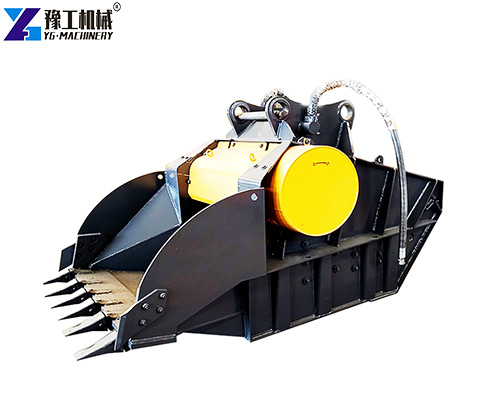
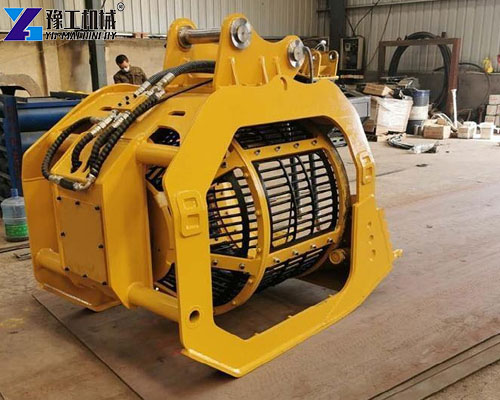
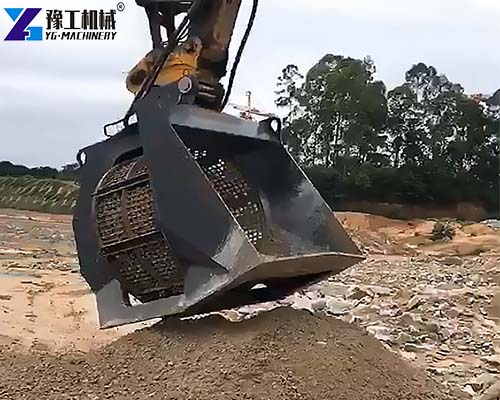
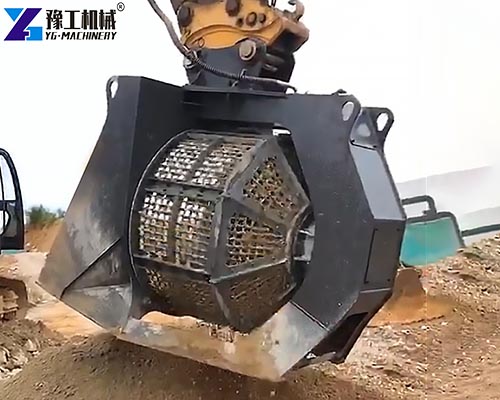
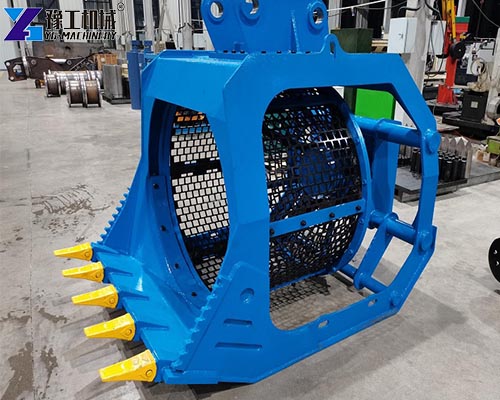
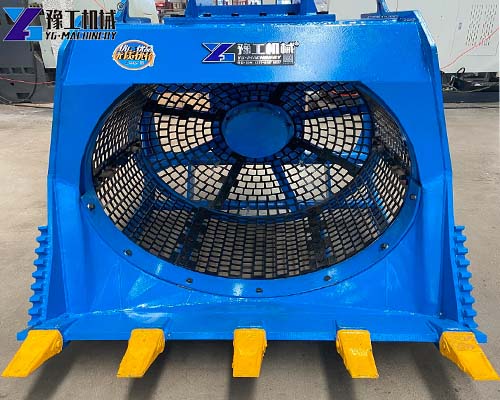
A rock screening bucket for an excavator is the solution. It’s a specialized excavator attachment featuring a rotating drum equipped with a mesh screen. The excavator’s hydraulic system spins the drum. As the drum rotates, fine materials like soil and sand fall through the mesh while larger rocks, roots, and debris are retained inside. The result: you screen material on-site, in one pass, without hauling it to a separate plant.
YG Machinery offers six digger screening bucket models: YG01, YG02, YG08, YG012, YG016, and YG018, covering excavator classes from 1.5 tons up to 38 tons. They feature hydraulically driven rotating drums, interchangeable mesh systems for different material sizes, high-strength steel construction, and self-cleaning capabilities that handle wet or sticky materials. They have extremely low operating costs compared to standalone screening plants, significant time savings over hauling material off-site, and durable construction that lasts for years in demanding conditions. They are suitable for different excavator sizes and project scales – from small landscaping jobs to large-scale demolition and recycling projects – and are a highly reliable choice for contractors who need to separate materials on-site efficiently.
But with six sizes and multiple configurations, how do you choose the right one? In this head-to-head comparison, we pit YG’s six screening buckets for digger models against each other and against standard buckets and off-site screening, focusing on excavator compatibility, operating flow, working pressure, weight, and project suitability.
Technical Specifications Of YG Digger Screening Bucket Models
All six models are hydraulically driven rotary screening buckets designed for mounting on excavators from 1.5 to 38 tons. Below are the core parameters.
| Model Number | Applicable Tonnage of Excavator(T) | Operating Flow(L/min) | Working Pressure(Mpa) | Self Weight(Kg) | Number of Revolutions Per Minute(RPM) |
| YG01 | 1.5-3 | 20 | 10-12 | 158 | 35 |
| YG02 | 3.5-5.5 | 30 | 10-12 | 245 | 60 |
| YG08 | 6-10 | 45 | 12-15 | 530 | 65 |
| YG012 | 11-18 | 65 | 15-18 | 1020 | 65 |
| YG016 | 19-28 | 80 | 18-22 | 1920 | 65 |
| YG018 | 29-38 | 150 | 18-22 | 2430 | 65 |
All models feature a rotating drum design with interchangeable mesh screens. The drum rotation speed ranges from 35 RPM on the smallest model to 65 RPM on the larger models. The self-weight ranges from 158kg up to 2430kg, matched to the excavator size for optimal stability and performance.
YG Digger Screening Buckets vs Standard Buckets And Off-Site Screening
Many contractors still use standard buckets and haul material to off-site screening plants. Others try static riddle buckets that rely on manual shaking. Neither approach is efficient. Let us break down four critical dimensions and compare YG rotary screening buckets to these alternatives.
On-Site Screening vs Hauling Off-Site: With a standard bucket, you dig the material, load it into trucks, haul it to a screening plant, process it, then haul the screened material back. That’s two extra haul cycles – more fuel, more labor, more time. A digger screening bucket screens material right where you dig it. You dig, screen, and place the finished material in one operation. By pre-sorting on-site, you minimize the need for transportation back to the yard or to landfills, reducing costs and processing times. On a typical job, this translates to 40-50% lower material handling costs.
Screening Speed and Productivity: Static riddle buckets require the operator to shake or vibrate the bucket manually – slow, tiring, and inconsistent. YG’s rotary screening bucket uses the excavator’s hydraulic system to spin a heavy-duty drum at up to 65 RPM. The material rolls, collides, and rubs inside the drum. Under centrifugal force and gravity, material that meets the screen size falls through; larger particles remain in the drum and are discharged from the other end. This continuous, powered screening is much faster than any manual method. A typical screening bucket can process 15 to 30 cubic yards per hour.
Material Versatility and Adaptability: Standard buckets handle only digging and moving. Static riddle buckets struggle with wet or sticky materials that clog the screen. A rotary screening bucket handles a wide variety of materials: topsoil, sand, gravel, rocks, demolition debris, compost, wood chips, coal, and ore. The interchangeable mesh system lets you change screen sizes to match your material – from fine sand to large rocks. The rotating action also provides a self-cleaning effect: because the material is constantly turning and rolling within the drum, sticky material that would clog a flat screen is ejected through the discharge opening.
Equipment Utilization: Off-site screening ties up multiple machines – excavators, loaders, trucks, and the screening plant itself. A digger screening bucket turns one excavator into a mobile screening plant. You can move the screening operation anywhere the excavator can go – across uneven terrain, into tight spaces, around obstacles. No separate screening plant to transport and set up. One machine does the work of three.
Core Advantages Of YG’s Digger Screening Bucket Over Standard Buckets And Off-Site Screening
- Hydraulic Drum Drive with Stepless Speed Control: YG screening buckets use a hydraulic motor to drive the drum. The operator can adjust the drum speed according to material properties and screening requirements. Slow down for wet or sticky materials to prevent clogging. Speed up for dry free-flowing materials to maximize throughput. This stepless speed control gives you complete control over the screening process – something static buckets cannot offer.
- Interchangeable Mesh System for Different Materials: The screen mesh on YG buckets is designed to be detachable and replaceable. You can select different hole sizes according to the particle size of your material. Need to screen fine sand? Install a small-mesh screen. Need to separate rocks from backfill? Install a larger-mesh screen. The replacement process is simple and fast without the need for complex tools. One bucket handles multiple materials with a quick screen change.
- Heavy-Duty Construction for Demanding Conditions: YG screening buckets are built from high-strength steel with wear-resistant materials. The rotating drum is designed to withstand the impact of rocks and demolition debris. Wear edges are bolt-on and easy to replace, reducing downtime and maximizing productivity. With proper maintenance – regular cleaning of the screen and lubrication of moving parts – a YG screening bucket lasts for years of daily use.
- Self-Cleaning Capability for Wet or Sticky Materials: One of the biggest problems with screening equipment is clogging. Wet soil, clay, or sticky demolition debris can block the screen and stop production. YG’s rotating drum design solves this. The constant tumbling action within the drum prevents material from sticking. Fine material falls through; larger material is ejected through the discharge opening. You spend less time cleaning screens and more time screening material.
Which Digger Screening Bucket Model Should You Choose?
Here is straightforward advice based on your excavator size and typical applications.
Choose YG01 if your excavator is 1.5-3 tons. You work on small landscaping jobs, garden topsoil screening, or light material separation. The 158kg self-weight keeps your mini excavator balanced. The 20 L/min operating flow matches small excavator hydraulics. The 35 RPM drum speed is ideal for light materials. Best for landscapers and small contractors.
Choose YG02 if your excavator is 3.5-5.5 tons. You handle small- to medium-sized screening jobs – residential site work, small demolition debris sorting, or agricultural material screening. The 245kg weight provides good stability. The 30 L/min flow and 60 RPM speed give you faster screening than the YG01. Most popular model for smaller excavators.
Choose YG08 if your excavator is 6-10 tons. You work on medium-sized projects – topsoil cleaning for large landscapes, backfill screening for utility trenches, or construction debris sorting. The 530kg weight is well-matched to this excavator class. Working pressure of 12-15 MPa and 45 L/min flow provide ample power. The 65 RPM drum speed delivers high throughput. Ideal for general contractors who do a mix of jobs.
Choose YG012 if your excavator is 11-18 tons. You handle larger projects – commercial site development, road construction material processing, or demolition recycling. The 1020kg weight provides excellent stability. Working pressure of 15-18 MPa and 65 L/min flow give you the power to handle heavy materials. This is the most popular model for medium-to-large contractors.
Choose YG016 if your excavator is 19-28 tons. You work on major projects – large-scale demolition, quarry material processing, or heavy recycling operations. The 1920kg weight is built for heavy-duty work. Working pressure of 18-22 MPa and 80 L/min flow handle the toughest materials. The 65 RPM speed maintains high productivity even with dense material.
Choose YG018 if your excavator is 29-38 tons. You handle the largest jobs – major demolition sites, large quarry operations, or industrial recycling facilities. The 2430kg weight is the heaviest in the lineup, providing maximum stability and durability. The 150 L/min operating flow delivers the power needed for high-volume screening. This is the top-of-the-line model for heavy-duty screening operations.
Avoid standard buckets if you regularly need to separate materials by size – topsoil from rocks, sand from gravel, or clean fill from demolition debris. The extra hauling and processing costs simply cannot compete with a digger screening bucket.
Upgrade Your Excavator For On-Site Screening Today – Get The Right Digger Screening Bucket For Your Machine
Stop hauling material off-site and paying twice for handling. YG Machinery – Shaping Tomorrow Since 2005 – has supplied rock screening buckets for excavators to contractors working in landscaping, demolition, recycling, and construction worldwide. Our hydraulically driven rotary buckets, interchangeable mesh systems, and heavy-duty construction are proven in the toughest conditions.
Contact us now for a free consultation. Tell us your excavator make, model, and tonnage, and describe the material you typically need to screen. We will recommend the right YG screening bucket model – and we will not push you toward a bigger bucket than you need.
Phone / WhatsApp / WeChat: +86 159 3715 3321
Email: admin@chinayugongmachinery.com